
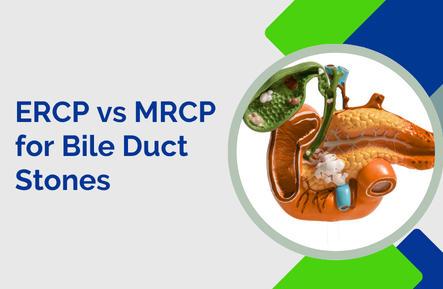
Both ERCP and MRCP examine the bile ducts, but they do different jobs. MRCP is a non-invasive MRI scan that only diagnoses, producing detailed images of stones, strictures or blockages without any instrument entering the body. ERCP is invasive, using an endoscope and dye, and its real strength is treatment: it can remove a stone in the same session it finds one. As a rule, MRCP confirms the problem and ERCP fixes it.
According to Dr. Ksheetij Kothari, one of the Best Gastroenterologist in Pune, I usually send a patient for MRCP first to confirm the stone, then reserve ERCP for when I actually need to clear the duct, because there’s no sense exposing someone to an invasive procedure just to look.
How Do ERCP and MRCP Actually Differ?
The two tests look similar on paper but split along one line: MRCP only sees, while ERCP sees and treats.
Feature | MRCP | ERCP |
Type | Non-invasive MRI scan | Invasive endoscopic procedure |
Purpose | Diagnosis only | Diagnosis and treatment |
Can remove stones | No | Yes, in the same session |
Radiation | None | Uses X-ray dye |
Main risks | Very few | Pancreatitis, bleeding, infection |
Usual role | Confirms the problem first | Clears the duct when needed |
Invasiveness: MRCP needs nothing more than an MRI machine, no scope, no dye, no sedation, while ERCP threads an endoscope down to the duct and carries the risks that come with that.
Treatment: This is the real divide. MRCP can only show the stone, whereas ERCP can pull it out in the same sitting it finds it.
Accuracy: Both pick up most stones well, though very small ones can slip past either test, which sometimes means a second look.
Sequence: For most patients it runs in order, scan first to confirm, procedure second to treat, which is where a planned ERCP procedure fits in.
When Do You Actually Need Each One?
Choosing between them comes down to one question: are we still confirming the diagnosis, or are we ready to treat?
Choose MRCP: When the picture isn’t clear yet, abnormal liver tests, a suspected stone, or a duct that looked dilated on ultrasound and needs confirming before anything invasive.
Choose ERCP: When a stone is already confirmed and blocking the duct, or when jaundice or infection means the obstruction has to be cleared fast.
Patient factors: MRCP is the safer route for anyone who can’t tolerate an invasive procedure, or whose surgical anatomy makes ERCP awkward.
Stent placement: When a duct needs a stent to stay open, ERCP is the one that delivers it, much like the planning behind a biliary stent placement.
So the honest answer to “which test do I need” is usually both, in order. The scan tells you what’s there, the procedure deals with it, and skipping straight to ERCP without confirmation just adds risk; a quick scan could have spared you.
Why Choose Dr. Ksheetij Kothari?
Dr. Ksheetij Kothari trained as a gastroenterologist through an MBBS, an MD in Internal Medicine, and a DM in Gastroenterology, with fellowships in Advanced Endoscopy and Endoscopic Ultrasound. Performing ERCP, and judging when a patient genuinely needs it rather than a scan, is a core part of his practice.
Many patients come in anxious, having been told they need a procedure without anyone explaining why. His approach is to confirm first and intervene only when it counts, sparing people invasive tests they don’t need. Match the test to the situation and outcomes improve. Rush it, and you take on risk for no reason.
Told you need a bile duct test and unsure which?
FAQs
Is MRCP safer than ERCP?
Yes, MRCP is non-invasive with very few risks, while ERCP carries procedural risks.
Can ERCP remove bile duct stones?
Yes, ERCP can both find and remove stones in the same session.
Why do an MRCP before ERCP?
MRCP confirms the problem first, avoiding an invasive procedure done just to look.
Does MRCP use radiation?
No, MRCP uses MRI technology and involves no radiation at all.