
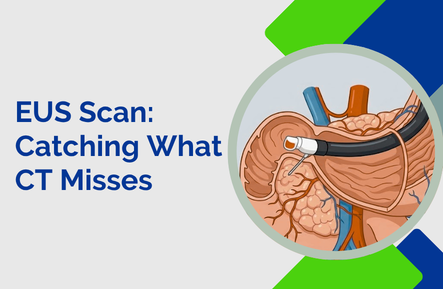
Endoscopic ultrasound, or EUS, places an ultrasound probe on the tip of an endoscope right next to the organ being examined, usually the pancreas or bile ducts. That closeness is the whole point. By sitting millimetres from the tissue, it produces far sharper images than a CT scan taken from outside the body, and it reliably picks up small tumours, stones and changes that CT can miss entirely. For pancreatic lesions under two centimetres, the difference is dramatic.
According to Dr. Ksheetij Kothari, one of the Best Gastroenterologist in Pune, When a CT comes back unclear but the symptoms worry me, EUS is what I reach for, because it sees small pancreatic lesions a scan from the outside simply can’t resolve.
Why Does EUS See What CT Cannot?
The advantage comes down to distance and resolution, the probe sits beside the organ rather than scanning through layers of body.
Proximity: The probe reaches the stomach or duodenum, right alongside the pancreas, so there’s no abdominal fat or gas blurring the picture the way there is with an external scan.
Small lesions: This is where the gap shows. For pancreatic tumours under two centimetres, EUS detects roughly 94 in 100, against about 50 in 100 for contrast CT.
The indeterminate scan: When a CT report says something is unclear or possibly there, EUS often settles it, picking up cancers in cases CT couldn’t confirm.
Sampling: EUS can do more than look. A fine needle can be passed through it to biopsy a suspicious area in the same sitting, which CT alone can’t manage, often through endoscopic services.
CT still has its place for the broad view and for spread to distant organs. But for the small, the early, and the uncertain, EUS is the sharper tool.
When Should You Have an EUS?
It isn’t a first scan for everyone, but in the right situation it answers questions nothing else can.
Unexplained symptoms: Persistent abdominal or back pain, weight loss, or jaundice where imaging hasn’t found a clear cause is a common reason to look closer with EUS.
A questionable CT or MRI: When an earlier scan flags something it can’t pin down, EUS is often the next step to confirm or rule it out.
Pancreatic and bile duct concerns: Suspected small tumours, cysts, or stones in the ducts are exactly what EUS is built to assess, including problems linked to drinking, as covered in pancreas pain after alcohol.
Staging a known cancer: If cancer is already found, EUS helps judge how deep it goes and whether nearby vessels or nodes are involved, which shapes treatment.
So EUS isn’t about replacing CT. It’s the closer look you bring in when the first scan leaves a question hanging, and that question matters.
Why Choose Dr. Ksheetij Kothari?
Dr. Ksheetij Kothari trained as a gastroenterologist through an MBBS, an MD in Internal Medicine, and a DM in Gastroenterology, with a dedicated fellowship in Endoscopic Ultrasound alongside Advanced Endoscopy. EUS of the pancreas and bile ducts, including needle sampling, is a core part of his practice.
Many patients reach him after a scan that raised concern without giving answers. His focus is using EUS to find the small things early, while they’re still treatable, and sparing people the limbo of an unclear result. Catch it early and the options stay open. Miss it, and they narrow fast.
Had a CT that didn’t fully explain your symptoms?
FAQs
Is EUS better than CT for the pancreas?
For small pancreatic lesions, yes; EUS detects far more than CT does.
Is an EUS painful?
No, it’s done under sedation and feels similar to a regular endoscopy.
Can EUS take a biopsy?
Yes, a fine needle can sample a lesion during the same procedure.
Does EUS use radiation?
No, it uses ultrasound, so there’s no radiation involved.