
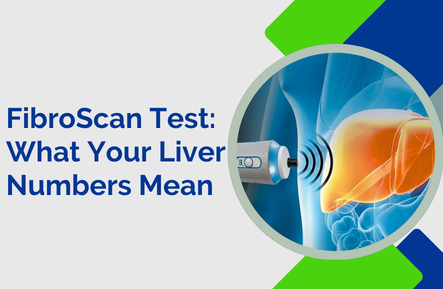
A FibroScan reports two figures. Liver stiffness comes in kilopascals, the kPa value, and reflects scarring: the lower it sits, the healthier the liver, while higher readings point toward fibrosis or cirrhosis. The second figure, the CAP score in decibels per metre, measures fat. Read together, they assess liver health without a biopsy.
According to Dr. Ksheetij Kothari,One of the Best Gastroenterologist in Pune, A FibroScan tells me in minutes what once needed a needle, and that means we catch scarring at a stage where the liver can still recover.
What Do the Stiffness and Fat Scores Tell You?
Each number measures a separate problem, and the two are best interpreted side by side rather than in isolation.
Stiffness, the kPa value: A reading of roughly 2 to 7 kPa is generally treated as normal. As scarring builds, the figure rises, and values into the high teens commonly indicate cirrhosis.
The CAP score: This one measures fat. Anything below 238 dB/m points to minimal fat; higher values track mild, moderate, then severe fatty change.
Why both matter: Consider that a liver can carry heavy fat with little scarring, or show significant scarring with only modest fat. Neither number alone settles the picture, but the pairing does.
The limits: Quick and painless as it is, the scan isn’t infallible. Borderline or surprising results occasionally call for further testing before anything is confirmed.
Numbers on their own diagnose nothing, which is exactly why interpretation belongs with a specialist. A proper FibroScan assessment places the score in context.
When Should You Get a FibroScan, and What Affects the Result?
The test fits anyone at risk of liver disease, but a handful of ordinary factors can shift the reading.
Who it suits: Fatty liver, hepatitis, sustained alcohol use, abnormal liver blood tests: these are the typical reasons a scan gets ordered, usually for monitoring.
Timing and food: A recent meal can push stiffness readings up. For that reason the scan works best after a few hours of fasting.
Body-related factors: Higher body weight, or fluid sitting around the liver, can interfere with accuracy. A specialised probe sometimes solves this.
One scan versus several: A single reading is only a snapshot. Repeated over months, the trend reveals whether the liver is recovering or deteriorating, which often tells you more than any one figure, much as a liver cirrhosis stage is tracked over time.
Why Choose Dr. Ksheetij Kothari?
Dr. Ksheetij Kothari trained as a gastroenterologist through an MBBS, an MD in Internal Medicine, and a DM in Gastroenterology, with fellowships in Advanced Endoscopy and Endoscopic Ultrasound. Non-invasive liver assessment, FibroScan among the tools, is a routine part of how he diagnoses and tracks liver disease.
Many patients arrive holding a report full of numbers nobody explained. His work is turning that score into a clear plan, catching scarring while the liver can still repair itself. Read early, the result guides action. Ignored, it stays just a number on paper.
Recently handed a FibroScan report you can’t decode?
FAQs
Is a FibroScan painful?
No, it’s a quick, non-invasive scan similar to an ultrasound.
What is a normal FibroScan score?
Liver stiffness around 2 to 7 kPa is generally considered normal.
Do I need to fast before a FibroScan?
Yes, a few hours of fasting improves the accuracy of the reading.
Can a FibroScan replace a liver biopsy?
Often yes, though some borderline cases still need a biopsy to confirm.