
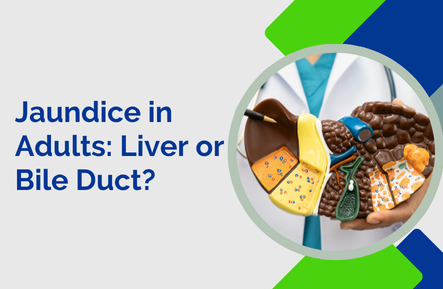
Adult jaundice happens when bilirubin, a waste product from red blood cell breakdown, collects in the blood. Three areas tend to be behind it: the liver, the bile ducts, or red blood cells breaking down too fast. In adults, the first two account for most of what we see. Liver-type jaundice points to hepatitis or cirrhosis, where damaged cells can’t process bilirubin. The bile-duct type means a blockage, a gallstone or tumour usually, and blood tests with imaging are what tell them apart.
According to Dr. Ksheetij Kothari,One of the Best Gastroenterologist in Pune, A liver function test usually tells me within minutes whether I’m dealing with the liver cells or a blocked duct ALT and AST point to one, ALP and bilirubin to the other and those two paths could not be more different.
What Causes Liver-Type Jaundice?
Damage the liver cells and they lose their grip on bilirubin, which then backs up into the blood until the skin yellows.
Hepatitis: Usually viral, and the classic trigger. The inflamed liver simply can’t push bilirubin into the bile any more, and in an otherwise well adult it’s one of the commoner reasons jaundice turns up at all.
Alcohol and cirrhosis: Drink heavily for long enough and the liver scars. Fibrosis crowds out the healthy tissue, bilirubin processing slips, and the yellow tinge comes on slowly, over weeks, not in a day.
Drugs and toxins: More medications do this than people expect. A few herbal supplements manage it too, which is usually the bit that catches patients off guard.
The clues: Tiredness, a queasy stomach, a liver that’s sore to press. That cluster leans toward the liver itself, away from the savage itch and pale stools of a blocked duct.
The common thread is where the fault lies, inside the liver tissue, not the drainage. Pinning it down tends to start with blood work and an ultrasound, and now and then an ERCP procedure.
When Does Jaundice Point to the Bile Duct?
Other times the liver is fine. The problem is mechanical: a blocked pipe, with bile that ought to reach the gut backed up behind it.
Gallstones: The usual offender, by some distance. A stone wedges in the duct, the flow halts, and conjugated bilirubin spills back into the blood.
Tumours: Painless jaundice with weight loss in an older patient points toward a pancreatic or bile-duct cancer obstructing the duct, rather than a gallstone, which usually causes pain.
Strictures and leaks: Sometimes a duct narrows, or gets nicked during gallbladder surgery, and drainage falters from there. Complications like bile leak are explained in more detail separately.
The tell-tale signs: Dark urine. Pale, clay-coloured stools. An itch that won’t quit. Read together, they finger the duct, not the liver.
Same yellow skin, then, two entirely separate stories underneath. Separating a blockage from liver disease is really the whole job, since one might need a procedure to open the duct while the other asks for the liver to be treated directly.
Why Choose Dr. Ksheetij Kothari?
Dr. Ksheetij Kothari trained as a gastroenterologist through an MBBS, an MD in Internal Medicine, and a DM in Gastroenterology, with fellowships in Advanced Endoscopy and Endoscopic Ultrasound. Working out what’s behind a patient’s jaundice, and clearing blocked bile ducts by ERCP, is a core part of his practice.
Plenty of patients arrive unsettled by the colour change, not knowing how worried to be. He concentrates on finding the cause fast and acting on it, because an obstructed duct can turn dangerous quickly. Catch it early and the right treatment follows. Guess at it, and you burn time the patient might not have.
Noticed yellowing skin or eyes and not sure why?
FAQs
Is jaundice always a liver problem?
No, it often stems from a blocked bile duct rather than the liver itself.
What colour are stools with bile duct blockage?
Pale or clay-coloured, because bile can’t reach the intestine normally.
Can jaundice go away on its own?
Sometimes, if mild and viral, but it always needs medical evaluation first.
Which test finds the cause of jaundice?
Blood tests and ultrasound first, with ERCP or MRCP for suspected blockages.