
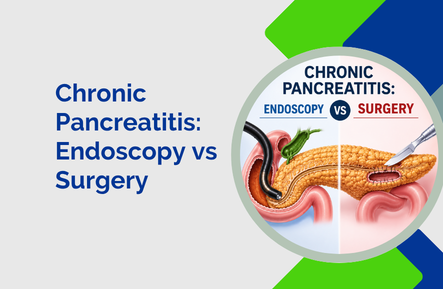
For most people with chronic pancreatitis, endoscopy is the right starting point, not surgery. When the pain is coming from a blocked or narrowed pancreatic duct, ERCP can clear the obstruction, place a stent, or remove stones without the recovery burden of an operation. Guidelines from major gastroenterology bodies consistently recommend trying endoscopic treatment first for obstructive chronic pancreatitis. Surgery becomes the answer when endoscopy has genuinely failed, when the anatomy makes endoscopic access impossible, or when there is a mass in the pancreatic head that raises concern for cancer. The decision isn’t a debate between two equal options it’s a staged approach, and most patients never need to get past stage one.
According to Dr. Ksheetij Kothari, a Gastroenterologist in Pune, “Surgery for chronic pancreatitis carries real risks, and in the right candidate, endoscopy gives comparable pain relief with a fraction of the recovery time. The problem is that patients often arrive having been told surgery is the only option before endoscopy has been properly tried.”
When Endoscopy Is the Right Call for Chronic Pancreatitis?
Endoscopic treatment works best when there is a clear mechanical reason for the pain, specifically a blockage in the main pancreatic duct that can be addressed through the scope.
Dominant ductal stricture: A single tight narrowing in the main pancreatic duct traps secretions upstream, building pressure and causing pain. ERCP allows dilation of the stricture with a balloon and placement of a plastic stent to keep it open. Over successive sessions, the stricture often remodels, and the stent can eventually be removed.
Pancreatic duct stones: Calcified stones blocking the duct are one of the most common causes of pain in chronic pancreatitis. Small stones can be extracted directly at ERCP. Larger ones need fragmentation first using extracorporeal shock wave lithotripsy (ESWL) before endoscopic removal. Most patients get meaningful pain relief once the duct is cleared.
Pseudocyst drainage: Fluid collections that form as a complication of chronic pancreatitis can be drained endoscopically using EUS guidance, without any incision. EUS-guided transmural drainage places a stent through the stomach or duodenal wall directly into the pseudocyst, which drains over days to weeks.
Failed conservative management: When pain medications, enzyme supplements, and dietary changes aren’t enough but ductal anatomy is still favourable, escalating to endoscopy before surgery is the standard next step.
Feature | Endoscopy (ERCP/EUS) | Surgery |
Invasiveness | Minimal, no incision | Major abdominal operation |
Recovery time | 1 to 3 days | 4 to 8 weeks |
Best suited for | Single stricture, accessible stones, pseudocysts | Failed endoscopy, complex anatomy, suspected malignancy |
Pain relief | Good in obstructive cases | More durable in complex disease |
Repeatability | Can be repeated as needed | One-time structural correction |
Anaesthesia risk | Conscious sedation | General anaesthesia |
For a full overview of the endoscopic procedures available for pancreatic conditions, the pancreatitis treatment page covers the ERCP and EUS options in detail.
When Surgery Becomes the Better Option?
Endoscopy has limits. There are specific situations where surgery consistently outperforms it, and pushing ahead with repeated endoscopic attempts in these cases only delays definitive treatment.
Endoscopy has already been tried adequately: Multiple ERCP sessions with stenting over 6 to 12 months without sustained pain relief is a reasonable trial. If the duct stays obstructed or pain returns quickly after each stent change, surgical drainage gives more durable results. The Puestow procedure or the Frey procedure creates a direct drainage channel between the pancreatic duct and the small intestine, bypassing the obstruction permanently.
Stones too large or impacted for endoscopy: ESWL combined with ERCP clears most stones, but some are too hard, too numerous, or positioned in side branches that the main duct scope can’t reach. Surgery can address these more comprehensively.
A mass in the pancreatic head: When imaging shows a mass and chronic pancreatitis and pancreatic cancer cannot be clearly distinguished, surgery serves both diagnostic and therapeutic purposes. Operating here is not just about drainage it removes the mass and gives a tissue diagnosis at the same time.
Bile duct involvement: Chronic pancreatitis in the head of the pancreas can compress the bile duct, causing obstructive jaundice. While a bile duct stent placed at ERCP manages this temporarily, surgery addresses both the bile duct and pancreatic duct obstruction in a single operation when long-term drainage is needed.
For more on what happens when the pancreas signals a problem through pain after alcohol, our previous blog on pancreas pain after drinking covers the connection between alcohol and pancreatic damage in detail.
Why Choose Dr. Ksheetij Kothari?
Dr. Ksheetij Kothari completed his DM in Gastroenterology from St. John’s Medical College, Bangalore, with advanced fellowships in Endoscopy and Endoscopic Ultrasound. He is actively involved in clinical trials on pancreatitis at Sahyadri Hospital, Pune, and his research on pancreatic and hepatic conditions has been published in international journals. ERCP for pancreatic duct clearance and EUS-guided pseudocyst drainage are part of his regular clinical practice, not referred out.
Patients with chronic pancreatitis are assessed with a full workup including MRCP for ductal mapping, EUS for structural detail, and functional tests where relevant. The decision between endoscopy and surgery is made after reviewing all of this, not before. Patients who come in having been advised surgery elsewhere are reviewed to check whether endoscopic options have genuinely been exhausted.
Book a Consultation today to understand whether endoscopy or surgery is the best approach to manage your chronic pancreatitis and relieve your pain.
FAQs
When is endoscopy preferred over surgery for chronic pancreatitis?
Endoscopy is preferred when chronic pancreatitis is caused by a dominant stricture or stones in the main pancreatic duct. ERCP with stone extraction, stricture dilation, or stent placement can relieve ductal obstruction and reduce pain without the risks of open surgery. It is the first-line approach in most guideline recommendations for obstructive chronic pancreatitis.
When does chronic pancreatitis require surgery instead of endoscopy?
Surgery is considered when endoscopic treatment has failed after an adequate trial, when there are large impacted stones that cannot be fragmented endoscopically, when a mass in the head of the pancreas raises concern for malignancy, or when a large inflammatory pseudocyst requires drainage that endoscopy cannot adequately achieve.
Is chronic pancreatitis curable?
Chronic pancreatitis is not curable. The scarring and loss of pancreatic tissue already present cannot be reversed. Treatment goals are to control pain, prevent further damage, manage complications, and replace lost exocrine and endocrine function with enzyme supplements and diabetes management where needed.
What is the role of EUS in chronic pancreatitis?
EUS provides high-resolution imaging of the pancreas and is used to assess ductal changes, detect complications like pseudocysts, guide drainage of fluid collections, and differentiate chronic pancreatitis from pancreatic cancer when a mass is present. It is also used before ERCP to plan the endoscopic approach.
Disclaimer
This blog is for educational and informational purposes only and is not a substitute for professional medical advice, diagnosis, or treatment. Please consult a qualified gastroenterologist or healthcare professional for guidance specific to your symptoms, risk factors, and individual medical history.