
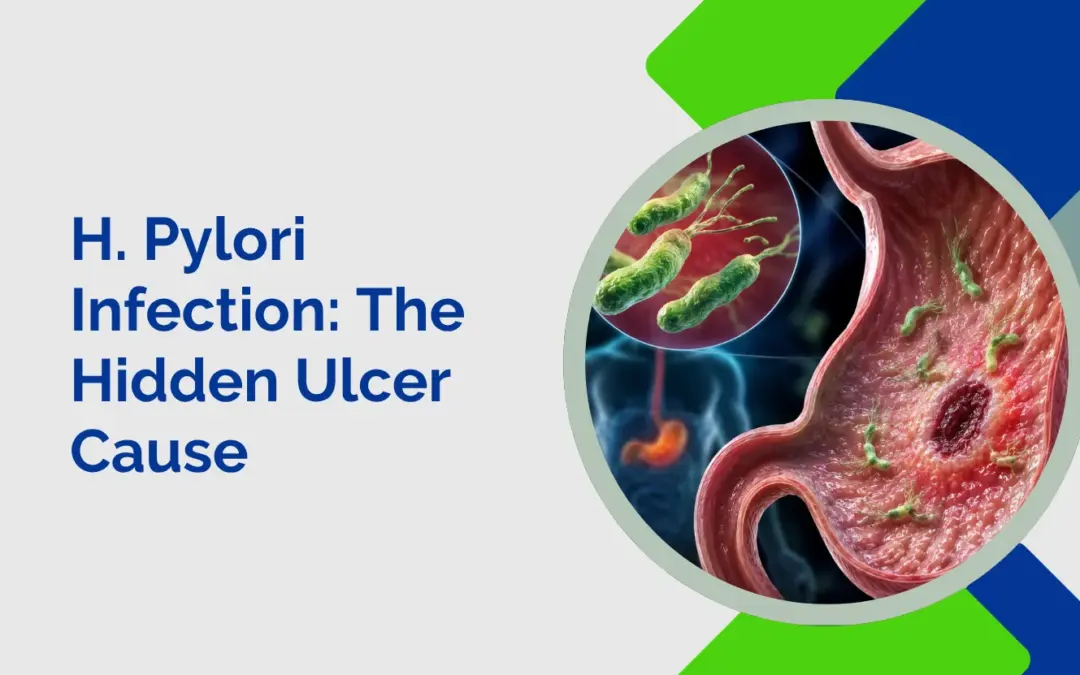
A spiral shaped bacterium living in the stomach lining explains a large share of peptic ulcer cases seen at the hospital. H. pylori damages the stomach’s protective lining and is one of the most common reasons peptic ulcers form in the first place. It infects roughly half the world’s population, and most carriers never know it’s there until damage shows up on endoscopy. Left alone for years that quiet colonization often turns ordinary acidity into an actual ulcer.
According to Dr. Ksheetij Kothari, recognized as one of the Best Gastroenterologist in Pune, “H. pylori doesn’t announce itself. Most patients come in for vague bloating or mild discomfort and testing turns up an infection that’s probably been active for years. Catching it early before an ulcer forms changes the whole treatment conversation.”
What Causes an H. Pylori Infection?
It spreads more easily than most people think. Knowing how it gets in explains a lot about peptic ulcer causes in general.
Contaminated food and water carry the bacteria: Poor sanitation is usually where it starts. A lot of people pick this up as kids, long before any symptom shows up.
Close contact spreads it within families: Sharing utensils, saliva, even a spoon used by an infected family member. That’s often enough. Household clustering is well documented and it’s not a coincidence.
It survives stomach acid by neutralizing it locally: It makes an enzyme that raises the pH in its immediate surroundings, just enough of a buffer to settle in and start multiplying. Very few other organisms can manage to survive there. That’s the trick.
Years can pass without a single symptom: That’s the part people miss. Most infections stay quiet for years.
Figuring out if H. pylori is behind the pain takes an actual test, not a guess. Peptic ulcer treatment begins with getting that answer first.
What Are the Symptoms of H. Pylori Infection?
The symptoms tend to blend into regular indigestion, which is probably why so many cases slip past unnoticed. Strange, given how common this infection is, that most people only hear its name after a test flags it.
Bloating and early fullness: Feeling stuffed after a small meal is one of the more frequent complaints. Patients usually blame it on poor digestion first.
Gnawing or burning pain: A dull ache in the upper stomach. It can ease for a bit right after eating, then come right back a few hours on.
Frequent burping and nausea: Mild nausea on and off, plus burping that never quite settles the stomach the way it should.
Unexplained weight loss: Not as common, but flag it quickly if it happens. Paired with constant tiredness, it can mean the infection has been around longer than expected.
Can’t tell if it’s an ulcer or gastritis? Doctors usually read more into the pain pattern than the symptoms themselves.
Why Choose Dr. Ksheetij Kothari for H. Pylori Treatment?
Dr. Ksheetij Kothari completed his DM in Gastroenterology at St. John’s Medical College, Bangalore, with fellowships in Advanced Endoscopy and Endoscopic Ultrasound. With H. pylori his first move is confirming the infection is actually there, not assuming it from symptoms alone. Antibiotic choice depends on that confirmation along with resistance patterns seen locally. He doesn’t run the same regimen for every patient. He builds it around what the tests actually show, and that’s a big reason patients across the city consider him among the best gastroenterologist in Pune for H. Pylori Infection.
Bloating or stomach pain that won’t quit deserves a real diagnostic workup, not another round of antacids. Call 9765180181 to get tested and start treatment that’s actually built for what’s found.
Persistent stomach discomfort deserves an actual answer, not just antacids. Get clarity in one visit.
FAQs
What causes an H. pylori infection?
Mostly contaminated food or water, sometimes close contact with someone infected.
What are common H pylori infection symptoms?
Bloating, a burning stomach pain, nausea, and burping that never really helps.
How is H. pylori diagnosed?
Through a breath test, stool antigen test, or endoscopy with biopsy.
Can H. pylori infection be cured?
Yes, a short course of combination antibiotics clears most infections in weeks.
References:
- NCBI Bookshelf (StatPearls) — Helicobacter Pylori: https://www.ncbi.nlm.nih.gov/books/NBK534233/
- NCBI Bookshelf (StatPearls) — Urea Breath Test: https://www.ncbi.nlm.nih.gov/books/NBK542286/
Disclaimer
This blog is for educational purposes only and isn’t a substitute for professional medical advice; consult a qualified doctor for any symptoms or concerns.