
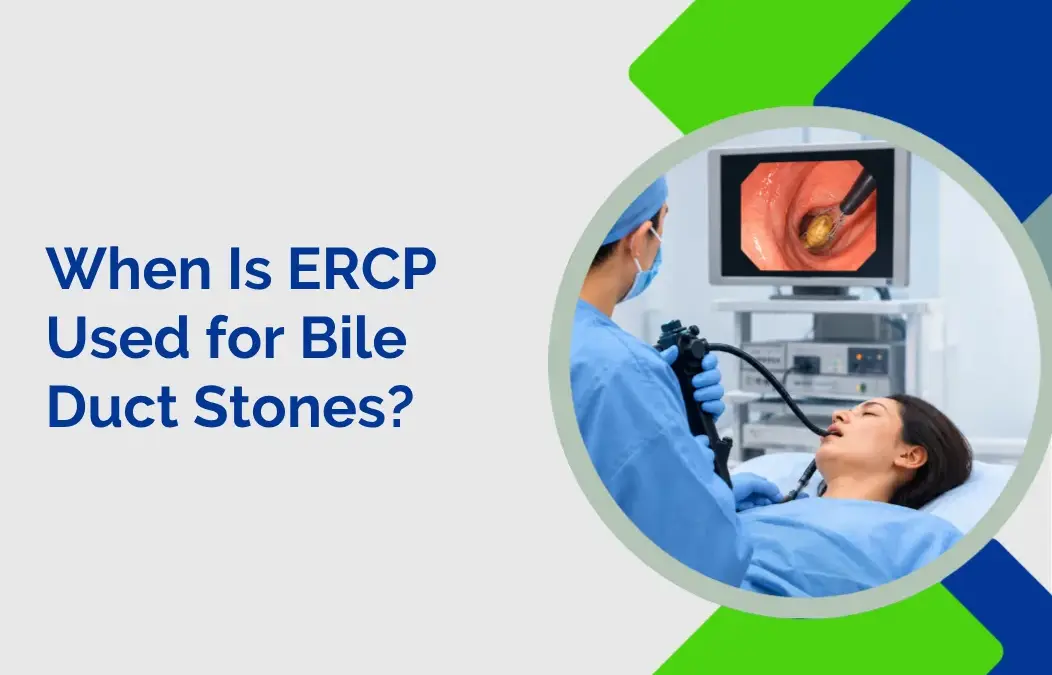
ERCP comes into play once a gallstone leaves the gallbladder and lodges in the main bile duct. That blockage doesn’t stay harmless for long. Infection, jaundice, even acute pancreatitis can follow if it’s left alone. This is the exact scenario the ERCP procedure exists to fix.
According to Dr. Ksheetij Kothari, recognized as one of the best Gastroenterologist in Pune, “ERCP isn’t the first step for every gallstone. It’s for stones that have already moved into the bile duct and are causing a blockage.”
When Does a Bile Duct Stone Require ERCP?
Not every gallstone needs this procedure. It’s kept for one specific situation.
A stone has actually migrated into the bile duct: ERCP treats choledocholithiasis. A stone still sitting quietly inside the gallbladder doesn’t call for it.
Blood tests point toward blockage: elevated bilirubin or liver enzymes turn up alongside imaging findings, and together they usually confirm a stone is obstructing bile flow.
Symptoms suggest a complication has already started: jaundice. Fever. Abdominal pain that reaches toward the back. Any of these can mean infection or pancreatitis is underway.
Imaging can find the stone but can’t remove it: an ultrasound or MRCP will spot where it sits. Clearing it out is what ERCP actually does.
Confirming whether a stone needs this kind of intervention takes proper imaging first, never assumption. The ERCP procedure here gets used only once that blockage is clearly confirmed.
What Happens During ERCP for Bile Duct Stones?
The procedure pairs endoscopy with real time imaging to find and clear the stone in one sitting.
A thin scope makes its way to the bile duct opening: it travels through the mouth and stomach and reaches the duodenum, where the duct empties.
Contrast dye lights up the duct on X-ray: this gives the doctor a clear picture of exactly where the stone sits and how big the blockage is.
A small cut widens the duct opening: this step, called a sphincterotomy, creates enough room for the stone to be pulled or flushed out.
Most patients are home within a day: recovery tends to move fast, since ERCP sidesteps the need for open surgery in most bile duct stone cases.
Bile duct stones and pancreatitis connect more often than most patients realize. Our piece on chronic pancreatitis pain looks at what happens when a blockage like this goes uncaught.
Why Choose Dr. Ksheetij Kothari for ERCP and Bile Duct Stones?
Dr. Ksheetij Kothari completed his DM in Gastroenterology at St. John’s Medical College Bangalore, with fellowships in Advanced Endoscopy and Endoscopic Ultrasound. ERCP demands precision that comes only from repetition, and he’s handled everything from a single straightforward stone to cases where scarring or unusual duct anatomy makes the approach itself the hard part. Before any procedure, imaging and lab work confirm exactly what’s blocking the duct and where. That groundwork is what lets him plan around the specific case instead of running a one size fits all approach.
A bile duct stone left alone tends to get worse, not better. Call 9765180181 to get it evaluated and treated properly.
Diagnosed with a bile duct stone and unsure if ERCP is the right next step?
FAQs
When is ERCP used for bile duct stones?
Mostly once a gallstone moves into the bile duct and blocks it.
Is ERCP always necessary for gallstones?
No. Only stones that have moved into the bile duct itself need it.
What are ERCP bile duct stones symptoms that need urgent care?
Jaundice, fever, or back pain from the abdomen mean it’s time for urgent care.
How long does recovery take after ERCP?
Most people are back to normal within a day or two.
References:
- National Institute of Diabetes and Digestive and Kidney Diseases (NIDDK) — Endoscopic Retrograde Cholangiopancreatography (ERCP): https://www.niddk.nih.gov/health-information/diagnostic-tests/endoscopic-retrograde-cholangiopancreatography
- NCBI Bookshelf (StatPearls) — Choledocholithiasis: https://www.ncbi.nlm.nih.gov/books/NBK441961/
Disclaimer
This blog is for educational purposes only and isn’t a substitute for medical advice. Consult a doctor for symptoms or concerns.