
Medically Reviewed by Dr. Ksheetij Kothari, MBBS, M.D (Medicine), D.M (Gastroenterology)
Hearing that ulcerative colitis is a chronic disease can sound like a life sentence, but it isn’t quite that simple. Chronic just means there’s no cure yet — it doesn’t mean constant symptoms or things only getting worse from here. Plenty of people diagnosed with it go on to live years, sometimes decades, mostly symptom-free, with the active disease showing up only occasionally in between. The real question worth understanding isn’t whether it’s chronic it clearly is but what keeps it that way, and what managing it well actually looks like over time.
“Chronic doesn’t mean constant. The patients who do well years down the line haven’t beaten the disease — they’ve learned to live alongside it, stayed on top of monitoring, and caught flares early instead of riding them out.” — Dr. Ksheetij Kothari, Gastroenterologist in Pune
What Causes Ulcerative Colitis to Persist Over Time?
The short version is that the immune system never really learns to leave the colon alone. Normally, it tolerates the bacteria and tissue involved in everyday digestion without issue. Somewhere along the way in ulcerative colitis, that tolerance breaks, and the immune system starts treating the colon’s own lining as a problem to fight — repeatedly, not once. There’s nothing external to clear out and move on from, the way there would be with an infection. That absence of a single fixable cause is really the whole reason this doesn’t just go away on its own.
Immune Dysfunction
Tap to read
The core driver — the immune system repeatedly attacks the colon’s own lining.
Genetics
Tap to read
Raises risk somewhat, though most people diagnosed have no family history.
Environmental Triggers
Tap to read
Smoking, infections, and other exposures can act as a spark.
Gut Microbiome Changes
Tap to read
Shifts in gut bacteria are thought to contribute in susceptible individuals.
Nobody fully understands why some people develop this immune misfire and others don’t, though genetics and environment both seem to be involved. A family member with the disease does raise the odds somewhat, but most people diagnosed can’t point to anyone else in their family who’s had it. Things like shifting gut bacteria, smoking, certain infections, and other environmental exposures appear to act as triggers in people who already carry some genetic susceptibility. And because that underlying tendency in the immune system sticks around for good, treatment is really about managing it rather than curing it outright.
Can Ulcerative Colitis Go Into Remission?
Yes, and for many people it isn’t just possible, it ends up being the default state for most of their life with the disease. But “remission” isn’t one fixed thing — it has layers to it. The most basic level, clinical remission, just means symptoms have calmed down: no blood, no urgent bathroom trips, nothing persistently wrong. Go a step further and there’s endoscopic remission, which means a colonoscopy actually shows the colon lining has healed, not just that symptoms have faded. Deeper still is histologic remission, a newer and stricter benchmark that checks whether inflammation has cleared even under a microscope.
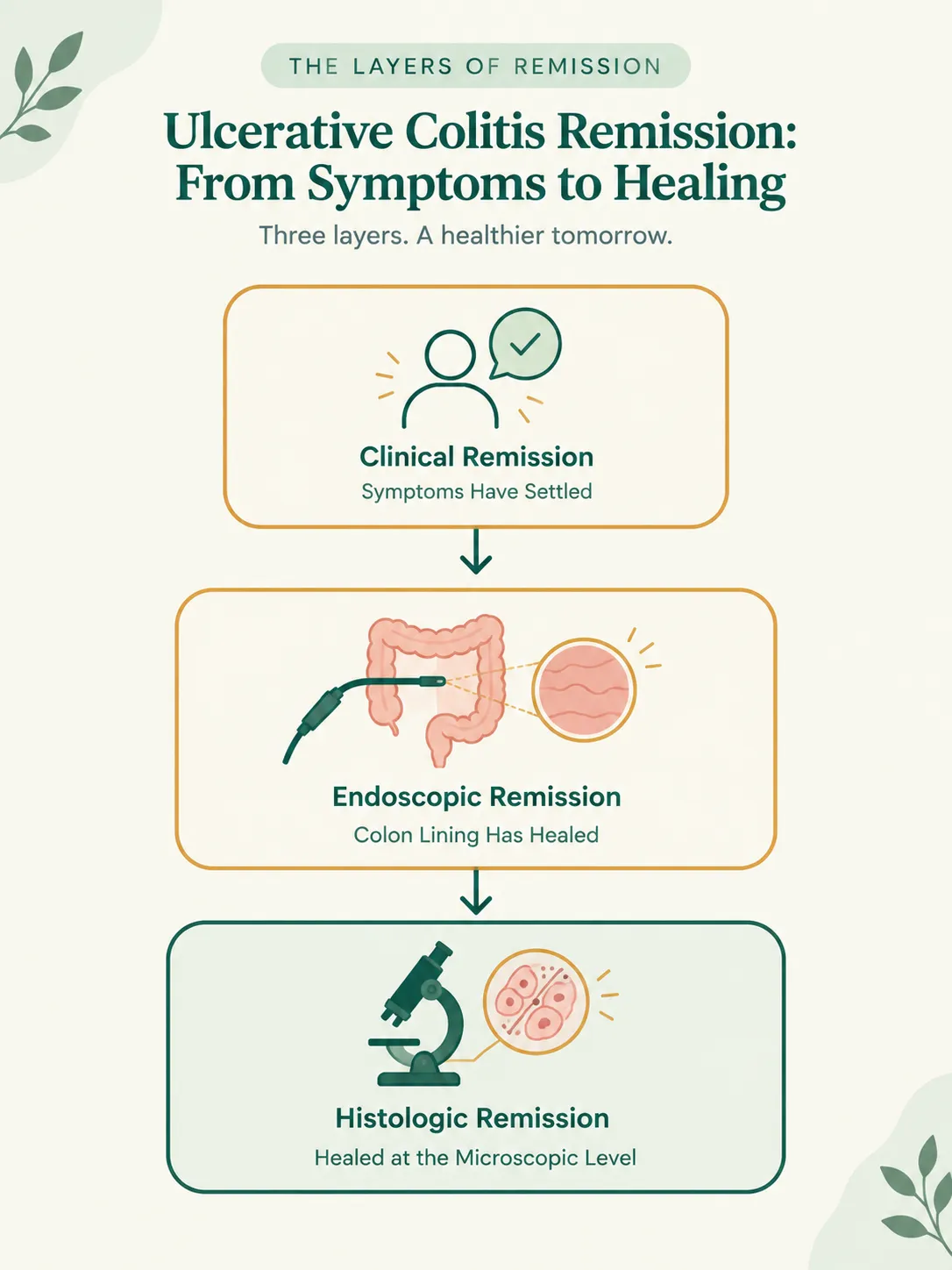
Why bother with all these layers? Because how someone feels and how healed they actually are don’t always line up. Study after study has found that patients who reach these deeper forms of remission, particularly endoscopic and histologic healing, end up with noticeably lower odds of relapsing, being hospitalized, or developing complications later. That’s the reasoning behind why many gastroenterologists now keep adjusting treatment even after symptoms disappear, rather than calling it done the moment someone feels better.
Quick Note: Getting to remission isn’t the finish line for treatment. It’s usually the ongoing medication that’s keeping things quiet, and stopping it just because symptoms are gone is one of the more common ways a flare sneaks back in.
A long-term condition deserves a long-term plan, not just symptom relief during flares
What Long-Term Problems Can Ulcerative Colitis Cause?
The longer the disease stays active, and the more of the colon it touches, the more colorectal cancer risk creeps up. Figures put it around 2% after a decade, rising to roughly 18% by the thirty-year mark — numbers high enough that surveillance isn’t optional, it’s built into standard long-term care. What’s really happening underneath is years of ongoing irritation slowly nudging cells toward abnormal changes, which is also why how long someone’s had the disease matters as much as how severe it’s been.
Colorectal Cancer
Tap to read
Risk rises with disease duration and extent — roughly 2% at 10 years, 18% at 30.
Bone Loss
Tap to read
Up to 60% of IBD patients have lower than average bone density.
Joint Pain (Arthritis)
Tap to read
One of the most common complications outside the gut.
Skin Issues
Tap to read
Inflammatory skin conditions can appear alongside active disease.
Eye Inflammation
Tap to read
Another extraintestinal manifestation linked to disease activity.
Primary Sclerosing Cholangitis
Tap to read
A liver condition involving the bile ducts, seen in a subset of patients.
Bones take a hit too, with around 60% of people with inflammatory bowel disease showing lower bone density than expected, a mix of the disease itself and years of steroid use catching up. And the trouble doesn’t always stay inside the gut — joints can ache, skin can flare up, eyes can get inflamed, and in some cases the liver develops a condition called primary sclerosing cholangitis. It’s a good reminder that despite the name, ulcerative colitis isn’t always just a colon problem.
How Is Chronic Ulcerative Colitis Managed Over the Long Term?
For milder disease, treatment usually starts with 5-ASA medications, moving up to immunomodulators, biologics, or newer targeted therapies if inflammation is more widespread or just isn’t responding. Simply controlling symptoms isn’t really the finish line anymore either — current guidelines lean toward reaching for stronger treatment sooner when it’s warranted, because the goal is the kind of deep healing that actually brings down long-term risk, not just a patient who feels okay for now.
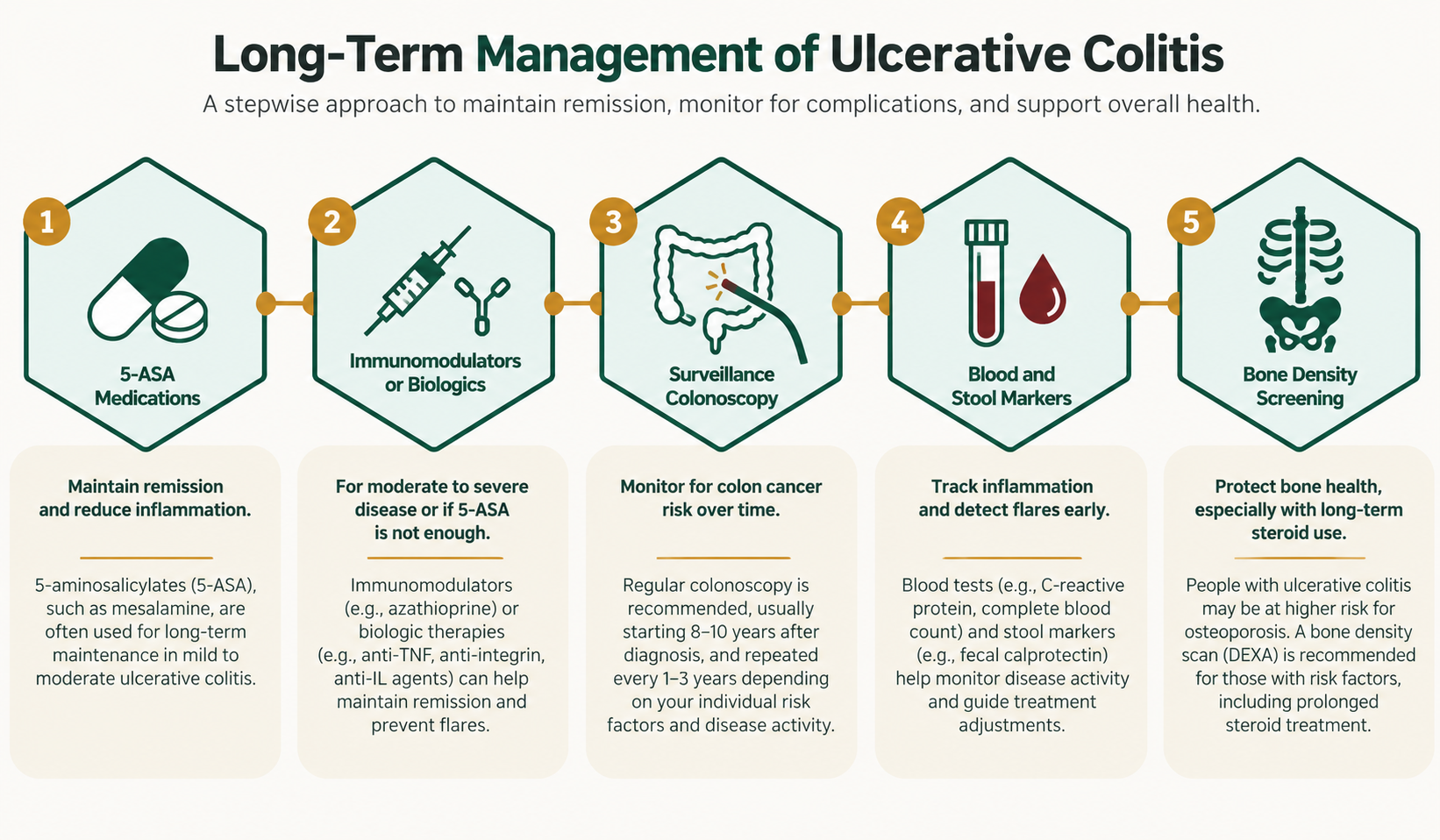
Surveillance colonoscopy usually enters the picture around the 8 to 10 year mark after diagnosis and keeps happening at regular intervals afterward, since this is how doctors catch changes early enough to still do something about them. Blood and stool markers fill in the gaps between those procedures, and bone density scans sometimes join the routine for anyone who’s been on steroids long-term. None of this swaps out for medication — it works alongside it, picking up on things symptoms alone would miss entirely.
Staying ahead of complications takes consistent monitoring, not just treatment during flares. Schedule a Follow-Up.
When Should You Consult a Gastroenterologist About Ulcerative Colitis?
Even once things have settled into remission, staying in touch with a gastroenterologist still counts for something, since inflammation has a way of creeping back quietly before any symptom gives it away. Scheduled visits, routine bloodwork, and surveillance colonoscopy on whatever timeline a doctor sets tend to serve people better than only showing up once something feels wrong. Skipping appointments simply because nothing hurts right now is one of the easier ways for early changes to slip by unnoticed.
Routine Follow-Up
- Steady remission, no new symptoms
- Scheduled bloodwork and markers
- Surveillance colonoscopy on schedule
- Mild, manageable medication side effects
Seek Prompt / Urgent Care
- New or worsening bleeding
- A flare not responding to usual treatment
- Unexplained weight loss
- High fever, severe swelling, or can’t keep food down
That said, certain things are worth moving the appointment up for rather than waiting it out — bleeding that’s new or getting worse, a flare that isn’t responding to the usual treatment, weight dropping for no clear reason, or medication side effects that have become genuinely hard to deal with. A high fever, serious abdominal swelling, or not being able to keep food down are different altogether and call for urgent care, not a routine visit, since they can point to something more serious happening.
Key Takeaway
Ulcerative colitis is a chronic, lifelong condition without a cure — but with consistent long-term management, most people spend far more time in remission than in flare.
Medical Disclaimer: This article is intended for general educational purposes only and does not replace an individual medical evaluation. Ulcerative colitis varies considerably between patients, and long-term management should always be personalized by a qualified healthcare professional.
FAQs
Is ulcerative colitis a lifelong condition?
Pretty much, yes. There’s no medication on the market today that cures it, so doctors treat it as something you manage for life, cycling between flares and quieter stretches. That said, a lot of people go years without symptoms once they find a treatment that actually works for them.
Can ulcerative colitis be cured?
Medication won’t cure it, no. Surgically removing the colon can technically get rid of intestinal symptoms for good, but that’s a serious step reserved for severe cases or ones that haven’t responded to anything else — not something doctors reach for routinely.
What does remission mean in ulcerative colitis?
It basically means the inflammation has settled down, though “settled down” isn’t always the same thing from person to person. Clinical remission is really just about how someone feels day to day, while endoscopic and histologic remission go further — they confirm the colon has actually healed, something only a colonoscopy or a look under the microscope can show.
Does ulcerative colitis increase cancer risk?
It does, and the risk tends to climb the longer someone’s had active disease and the more of the colon that’s been involved. That’s exactly why surveillance colonoscopy ends up becoming part of routine care somewhere around the 8 to 10 year mark — it’s less about expecting the worst and more about catching anything early.
How often should someone with UC see a gastroenterologist?
There’s no one-size-fits-all answer here — it really comes down to how active the disease has been. Even for people doing well in remission, most still benefit from checking in periodically, getting bloodwork done, and keeping up with surveillance colonoscopy on whatever schedule makes sense for their own risk profile.