
At first, a stomach ulcer may seem like a minor issue, however, things can take a turn for the worse when ulcer begins to bleed. Though the vast majority of peptic ulcers do not get that far, there are certain individuals who do experience this complication, particularly those who take NSAIDs or suffer from undiagnosed H. pylori infection. When the patient does bleed, it can either be slight enough not to present any complications, or the bleeding can be severe and require immediate medical help. What makes things particularly tricky is the fact that the beginnings of an internal bleeding case can be rather inconspicuous.
“A bleeding ulcer rarely announces itself the way people expect. Fatigue, dark stools, or a racing heart can be the only clues before things turn serious — which is why any of these symptoms deserve a prompt evaluation, not a wait-and-see approach.” — Dr. Ksheetij Kothari, Gastroenterologist in Pune
What Causes Internal Bleeding From a Stomach Ulcer?
A stomach ulcer usually starts the same way: something wears away the stomach’s lining faster than the body can rebuild it. Long-term NSAID use, painkillers like ibuprofen or aspirin, is one of the most common culprits, since these drugs blunt the stomach’s ability to produce protective mucus. Helicobacter pylori, a bacteria that can quietly live in the stomach for years, is the other major cause. Either factor, or both together, lets acid slowly wear a deeper hole into the stomach wall.
Symptoms That May Change Over Time
Protective lining is worn down
NSAID use or H. pylori infection weakens the stomach’s natural defenses.
An ulcer forms
Acid begins to erode a deeper hole into the stomach wall.
A blood vessel is exposed
The erosion reaches a vessel sitting underneath the ulcer.
Bleeding begins
Slow oozing or sudden rupture, depending on the size of the vessel involved.
Once that erosion reaches a blood vessel underneath, bleeding begins. Sometimes it’s a small vessel that oozes gradually, building up symptoms over days or weeks. Other times it’s a larger vessel that gives way suddenly, with bleeding severe enough to cause dizziness or fainting within minutes. A few things tip the odds toward bleeding: combining NSAIDs with blood thinners, older age, regular heavy drinking, or a past ulcer. None of these make bleeding certain, but they make it far more likely once an ulcer is already there.
Quick Note: Not every ulcer bleeds, and most people on NSAIDs never develop one that does. Risk climbs with dose, duration, and combination with other blood-thinning medications — it’s rarely a single factor acting alone.
What Are the Warning Signs of a Bleeding Stomach Ulcer?
Coffee-Ground Vomit
Tap to read
Black, Tarry Stools
Tap to read
Unexplained Fatigue
Tap to read
Paleness
Tap to read
Breathlessness on Activity
Tap to read
Gnawing Abdominal Pain
Tap to read
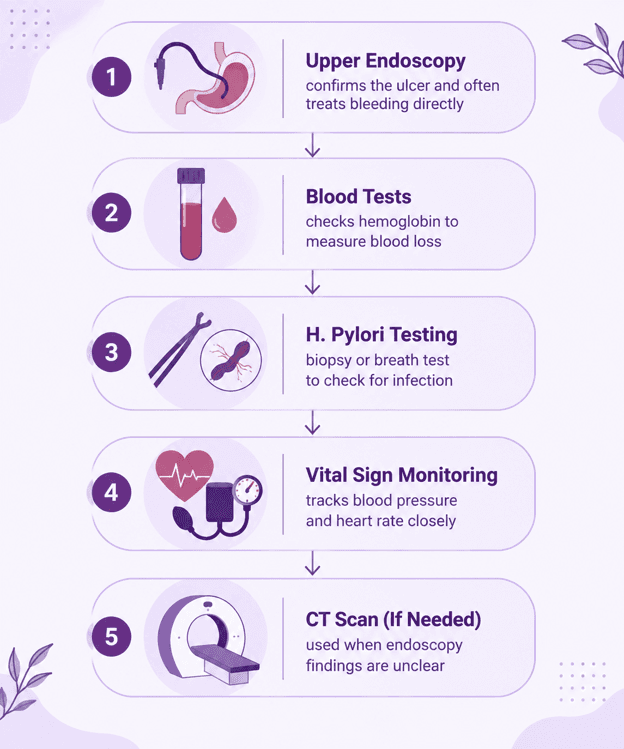
How Is a Bleeding Stomach Ulcer Diagnosed?
When Should You Seek Emergency Medical Care for a Bleeding Ulcer?
See a Doctor Soon
- Ongoing fatigue or paleness
- A stomach that feels persistently uneasy
- Mild, recurring abdominal discomfort
A previous ulcer with new mild symptoms
Seek Emergency Care
- Vomiting blood or coffee-ground vomit
- Black, tarry stools
- Fainting, lightheadedness, or racing heartbeat
- Sudden, severe abdominal pain
Sudden, severe abdominal pain belongs in that same urgent category, since it can sometimes mean the ulcer has perforated rather than just bled — a separate emergency in its own right. Milder symptoms that build slowly, like persistent fatigue or a stomach that won’t settle, still deserve a doctor’s attention soon, though not necessarily an ambulance ride. As a rough guide: visible blood or any sign of shock means straight to the ER, while everything else calls for prompt care, just not a sprint.
Key Takeaway
A bleeding stomach ulcer often gives quiet warning signs before it becomes an emergency — noticing them early is what keeps a slow problem from turning into a sudden one.
Medical Disclaimer: This article is intended for general educational purposes only and does not replace an individual medical evaluation. Ulcer symptoms and severity vary from person to person, and management decisions should always be personalized by a qualified healthcare professional.
FAQs
Is it possible for an ulcer of the stomach to bleed internally without pain?
Yes. Bleeding may happen without pain or even in the absence of pain, especially if the bleeding is slow and persistent. In these cases, the only signs are fatigue, paleness, or dark stools.
What does bloody vomit or poop look like?
The vomited blood will look like coffee grounds or streaks of red blood, and the blood in stool will usually turn it black, tarry, and very foul smelling, which is called melena.
How soon can a bleeding ulcer prove to be life-threatening?
This depends upon the size of the affected blood vessel. Bleeding from a small vessel might not be noticed for days and may cause a lot of blood loss from a larger vessel within minutes to hours of the bleeding.
Should endoscopy always be required to diagnose a bleeding ulcer?
In most cases, yes. Although endoscopy is not always the best choice, it is still the most accurate means of establishing the source of bleeding and direct treatment (often in the same procedure).
Is it possible to heal a bleeding ulcer without surgery?
Many bleeding ulcers can be treated successfully during endoscopy, by procedures which directly stop the bleeding, along with acid suppressing medication. Surgery is usually only an option if the bleeding cannot be controlled in this manner.