
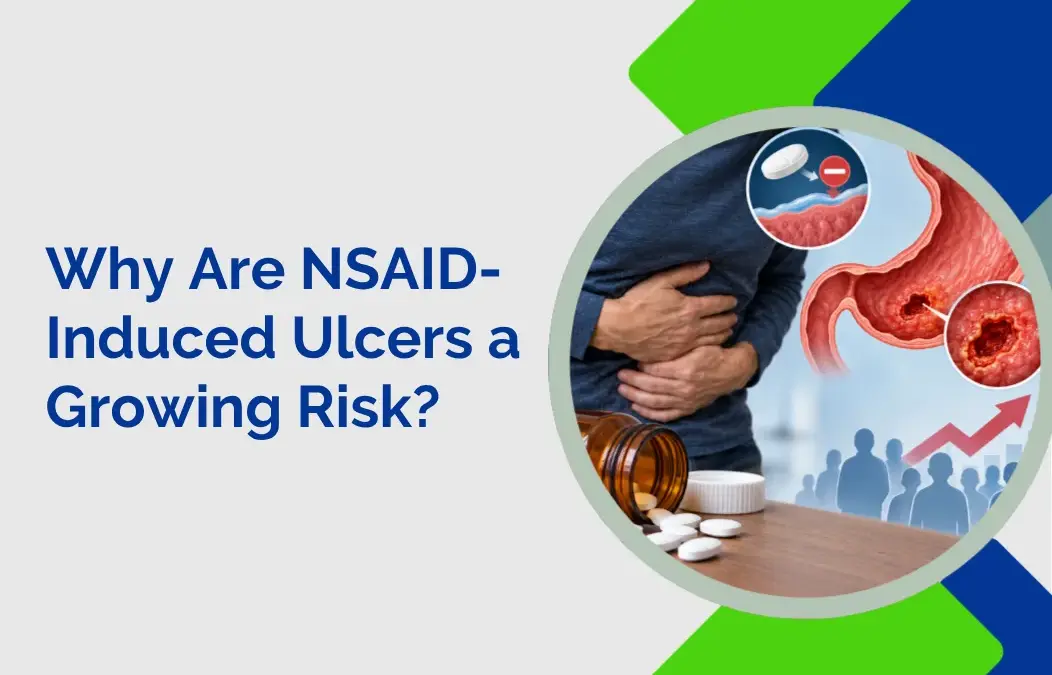
Common pain relievers carry a risk most people never think about. NSAIDs weaken the stomach’s protective layer and irritate the lining directly, which makes them one of the leading peptic ulcer causes. Many long term users develop damage without feeling a thing.
According to Dr. Ksheetij Kothari, recognized as one of the best Gastroenterologist in Pune, “Patients on long term NSAIDs often have no idea damage is building until bleeding shows up. Silent ulcers are far more common than people realize.”
Why Do NSAIDs Cause Peptic Ulcers?
NSAID induced ulcers follow a fairly specific mechanism. It goes beyond general irritation.
They block protective prostaglandins: these compounds shield the stomach lining, and NSAIDs shut down the enzyme that makes them.
They irritate the lining directly: many NSAIDs also have a corrosive effect once they reach the stomach.
Damage builds silently: up to 70 percent of long term users develop mucosal injury and feel nothing until a complication appears.
Some factors raise the risk sharply: older age, higher doses, and blood thinners taken alongside NSAIDs all push the odds up.
Finding out whether NSAIDs have already done damage takes an actual look, not a guess from symptoms. Peptic ulcer treatment here includes checking for exactly this in patients on long term pain medication.
Who Is Most at Risk From NSAID-Induced Ulcers?
Not every NSAID user faces the same odds. A few factors stack the risk.
Older adults: the stomach lining loses resilience with age, and this group tends to take NSAIDs more consistently for chronic pain.
Higher doses and longer use: an occasional pill for a headache carries far less risk than daily use for arthritis over months or years.
Blood thinners alongside NSAIDs: the combination raises ulcer risk and makes any bleeding more severe.
A past ulcer: anyone who’s had one before is far more likely to develop another on NSAIDs.
NSAID induced ulcers can bleed with little warning. Our piece on ulcer bleeding covers what that looks like once it starts.
Why Choose Dr. Ksheetij Kothari for NSAID-Induced Ulcers?
Dr. Ksheetij Kothari completed his DM in Gastroenterology at St. John’s Medical College Bangalore, with fellowships in Advanced Endoscopy and Endoscopic Ultrasound. Silent damage is the hardest part of NSAID induced ulcers to catch. Patients often feel fine right up until bleeding or a perforation forces the issue. His approach leans on endoscopy instead of waiting for symptoms, especially for patients on long term NSAIDs or blood thinners who’ve never been screened. That early look is often what catches damage before it becomes an emergency.
Long term NSAID use deserves a periodic check, not just a prescription refill. Call 9765180181 to get it evaluated.
Taking NSAIDs regularly for joint pain or arthritis without ever getting checked?
FAQs
Why are NSAID-induced ulcers a growing risk?
More people take NSAIDs long term, often unaware of the silent damage.
What are the symptoms of an NSAID induced ulcer?
Often none at first. Pain or bleeding can show up later.
Are NSAID induced ulcers a common peptic ulcer cause?
Yes. They rank second after H. pylori infection.
Can NSAID induced ulcers be prevented?
Often yes, through lower doses, shorter use, or added stomach protection.
References:
- PMC (NIH), Pharmacogenomics of NSAID-Induced Upper Gastrointestinal Toxicity: https://www.ncbi.nlm.nih.gov/pmc/articles/PMC8256335/
- NCBI Bookshelf (StatPearls), Peptic Ulcer Disease: https://www.ncbi.nlm.nih.gov/books/NBK534792/
Disclaimer
This blog is for educational purposes only and isn’t a substitute for medical advice. Consult a doctor for symptoms or concerns.