
Five years without a flare starts to feel like the disease has moved on. So when symptoms creep back — a little blood, a change in stool, that familiar urgency — the first reaction is usually disbelief. The honest answer is that yes, ulcerative colitis can flare after five years, or ten, or twenty. It’s a relapsing condition by nature, and a long remission lowers the odds of a flare without removing them entirely. The more useful question isn’t whether it can happen, but what tends to bring it back and what to do once it does.
“A long remission is genuinely good news, but it isn’t a cure. The patients who do best over decades are usually the ones who stayed on maintenance therapy and kept up with follow-up, even during the years when they felt completely fine.” — Dr. Ksheetij Kothari, Gastroenterologist in Pune
What Warning Signs May Indicate That Ulcerative Colitis Has Returned?
Most of the time, a returning flare looks like the original one did, which is part of what makes it so unsettling after five quiet years. Blood in the stool tends to be the giveaway, alongside diarrhea that won’t quite settle and a bathroom urgency that feels different from normal. A dull cramp on the lower left side often joins in too. What catches people off guard is the pace — it rarely arrives all at once, usually starting as a slightly looser stool that builds over a week or two before anyone takes it seriously.
Blood in Stool
Tap to read
Often the clearest and earliest sign that inflammation has returned.
Persistent Diarrhea
Tap to read
Loose stools that keep recurring rather than settling after a day or two.
Lower Left Cramping
Tap to read
A dull, recurring ache, often on the lower left side of the abdomen.
Unexplained Fatigue
Tap to read
Tiredness with no clear cause, sometimes appearing before digestive symptoms.
Low-Grade Fever or Joint Aches
Tap to read
Signs that inflammation isn’t staying confined to the colon alone.
The bowels aren’t always where it shows up first, though. Fatigue with no clear cause, a low-grade fever, joint aches, or a bit of unexplained weight loss can appear alongside the digestive symptoms — sometimes even before them. That’s simply how an immune-driven condition behaves; inflammation doesn’t always stay politely confined to the colon. Anything that lingers past a few days, especially with visible blood, is worth mentioning to a doctor rather than waiting it out to see if it passes on its own.
Quick Note: A flare after years of remission doesn’t mean the disease has turned more aggressive, or that earlier treatment somehow failed. Most flares respond well once treated, and plenty of patients settle back into long remission afterward.
What Can Cause Ulcerative Colitis to Flare Up After 5 Years?
Five years of quiet doesn’t mean the condition packed up and left — it just means it stayed dormant. By far the most common reason it stirs back up is stopping or skipping maintenance medication, which feels like a reasonable thing to do after years of feeling fine, but it quietly removes the one thing keeping inflammation in check. Research keeps landing on the same finding: medication non-adherence is the strongest identifiable trigger for flares, which is exactly why gastroenterologists push for continuing treatment even when nothing seems wrong.
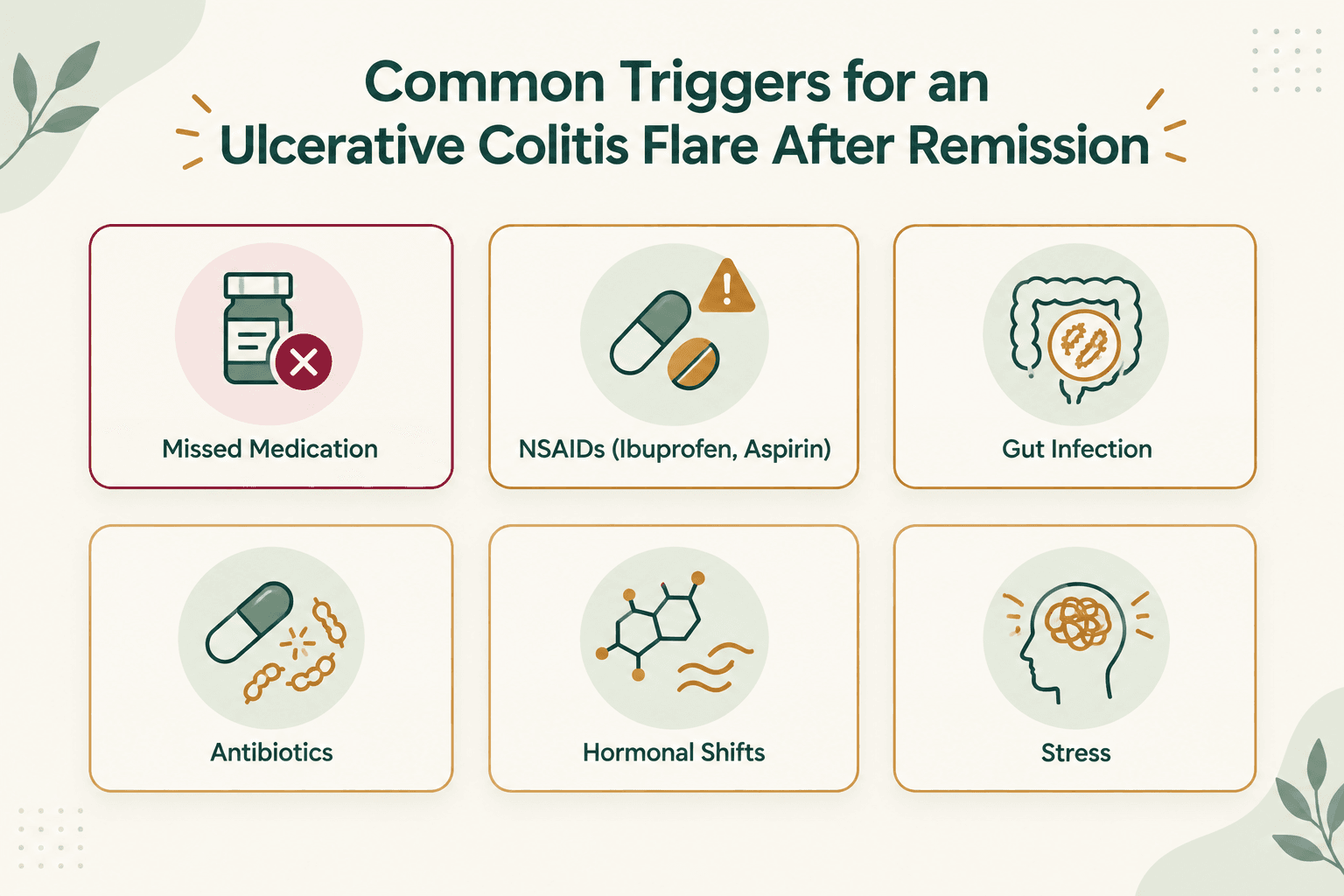
Beyond that, the triggers get harder to predict. NSAIDs — ibuprofen, naproxen, aspirin — have a well-documented habit of provoking flares and are generally worth avoiding. A gut infection, C. difficile in particular, can reignite inflammation, and certain antibiotics can do something similar by throwing off the gut’s bacterial balance. Hormonal shifts can play a role too — some patients notice changes in disease activity during pregnancy or the months after. Stress isn’t a cause of ulcerative colitis itself, but it can absolutely make symptoms worse. And sometimes, honestly, no trigger is ever found — frustrating, but not a sign anyone did anything wrong.
How Can You Reduce the Risk of Another Ulcerative Colitis Flare?
Sticking with prescribed maintenance therapy remains the single most reliable thing a patient can do, even through long stretches where everything feels normal. Regular follow-up carries just as much weight, since inflammation can show up on a colonoscopy or in stool markers well before any symptom does. Research backs this up clearly: patients whose colon lining has fully healed relapse far less often than those with even mild inflammation still lingering — which is exactly why doctors look past how someone feels day to day.
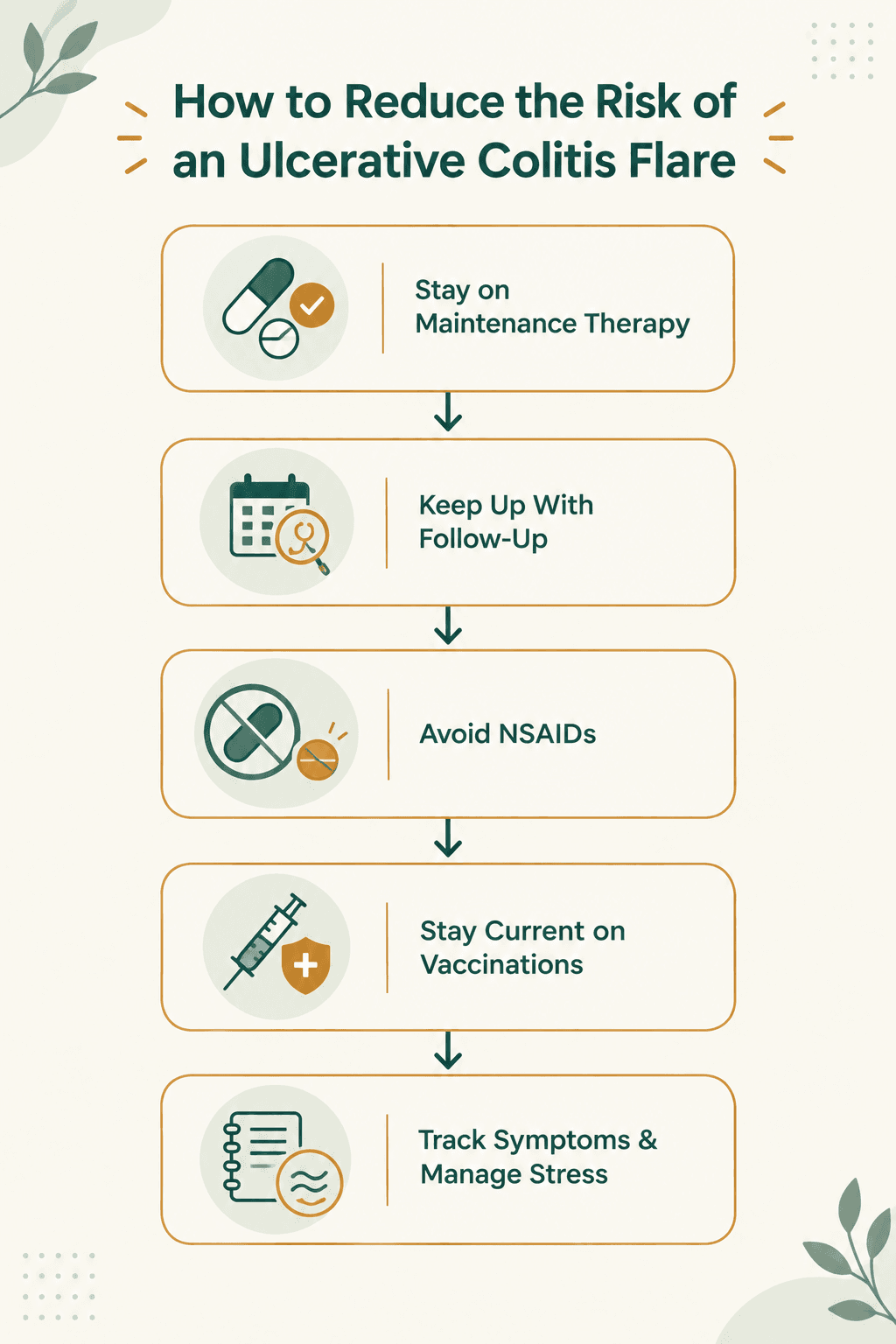
A handful of everyday habits help too. Reaching for paracetamol instead of NSAIDs for aches and pains, staying current on vaccinations to lower infection risk, and keeping a simple symptom diary can all make a real difference over time. Sleep and stress management deserve genuine attention here — not as a fix, but because both quietly shape how symptoms behave. No single diet prevents flares, though many people find it worthwhile to notice which foods tend to stir things up for them personally, rather than cutting things out broadly without reason.
When Should You Seek Urgent Medical Care for a UC Flare?
- A few days of looser stools
- Mild, occasional cramping
- Occasional streaks of blood
- General tiredness without other red flags
Seek Emergency Care
- 6+ bloody stools in a day
- Fever with a racing heartbeat
- Feeling faint or lightheaded
- Severe pain with visible abdominal swelling
Everything milder still deserves attention, just not a trip to the emergency room. A few days of looser stools, mild cramping, or the occasional streak of blood is reason enough to call a gastroenterologist within the week, since catching things early often stops a mild flare from turning into something bigger. The rule of thumb holds up well here: heavy bleeding, high fever, severe pain, or genuinely feeling unwell means go in now — gradual changes mean book the appointment soon, not urgently.
Key Takeaway
Ulcerative colitis can flare after five years of remission — staying on maintenance therapy and keeping up with follow-up is what keeps those quiet years going. For more on what long-term outlook actually looks like, see this related read on IBD prognosis.
FAQs
Is it possible for ulcerative colitis to return after 5 years of remission?
Yes. It’s a chronic and recurring disease and a flare can happen after a period of time. The longer the period of stability the less the chances, but not none.
If my flare up after a number of years of remission is a sign that my disease has gotten worse?
Not necessarily. After a period of time, a flare does not necessarily indicate that the disease is now more aggressive. Most of them are responsive to treatment and many patients achieve a durable remission following treatment.
Which of the following is the most frequent cause of a UC flare during long remission?
The most common trigger is to stop or skip maintenance medication. Research after research has shown that medication adherence is the number one predictor of relapses.
Does stress cause an ulcerative colitis attack?
Although stress alone does not cause UC, it can aggravate the condition and push the stage towards a flare in individuals with a predisposition to flare.
Does it make sense to keep patients taking maintenance medications during remission?
In most cases, yes. During remission, it is the maintenance therapy which suppresses inflammation. Don’t stop treatment without talking to a gastroenterologist.
Medical Sources
- “Causes of Flares” — Crohn’s & Colitis Foundation
- “Ulcerative Colitis: Symptoms, Causes, Diagnosis & Treatment” — Cleveland Clinic