
Medically Reviewed by Dr. Ksheetij Kothari, MBBS, M.D (Medicine), D.M (Gastroenterology)
Seeing “dilated pancreatic duct” on a scan report is unsettling, and understandably, the first thing most people search for is whether it means cancer. The honest answer is: not necessarily, but it’s not something to brush off either. A dilated duct is a physical finding, not a diagnosis on its own — it simply means something, somewhere, is narrowing or blocking the duct’s normal flow. That something could be old scarring from a mild bout of pancreatitis years ago, or it could be an early clue worth paying closer attention to. Telling the two apart is really the whole point of a proper workup.
“A dilated pancreatic duct is a finding, not a diagnosis. It can come from something as straightforward as a prior episode of pancreatitis, or it can be an early clue worth paying attention to — the only way to know which is to look closely.” — Dr. Ksheetij Kothari, Gastroenterologist in Pune
What Causes a Dilated Pancreatic Duct?
A pancreatic duct widens when something further down the line blocks or narrows its normal path, letting pressure build up behind the obstruction. Chronic pancreatitis is one of the usual suspects here — years of inflammation gradually leave behind scarring, narrowed segments, and sometimes small stones that physically pinch the duct. A tumor sitting in or near the duct can produce the exact same effect, whether by pressing on it from outside or growing within it. Even a cyst-like growth called an IPMN can clog the duct from the inside with thick mucus.
Chronic Pancreatitis
Tap to read
Years of inflammation leave scarring, strictures, and sometimes stones.
Pancreatic Tumor
Tap to read
Can obstruct the duct from outside or grow within it directly.
IPMN
Tap to read
A mucus-producing cystic growth that can block the duct from inside.
Duct Stones
Tap to read
Small calcified deposits that physically narrow the passage.
Strictures
Tap to read
Narrowed segments, often from prior inflammat
Incidental / Mild Widening
Tap to read
A few millimeters of dilation with no clear cause, often harmless
Not every dilation tells the same story, and size tends to matter more than people assume. A few millimeters of widening is often incidental — the kind of thing that turns up on a scan ordered for something else entirely and means little on its own. Dilation past 5 to 10 millimeters is a different matter, particularly when there’s no obvious explanation like old pancreatitis sitting in the history — that’s usually when further testing gets recommended. In the end, the finding is just a starting point. The real question is always what’s behind it.
Quick Note: Most dilated pancreatic ducts turn out to have a benign explanation, especially when found by chance with nothing else going on. A dilated duct is reason enough to look into it, not reason to assume the worst.
A pancreatic duct finding on a scan deserves a proper look before jumping to conclusions.
What Symptoms May Occur With Pancreatic Duct Dilation?
It’s genuinely common for a dilated pancreatic duct to be found by accident — spotted on a scan done for something unrelated, with no symptoms pointing to it at all. When symptoms do turn up, upper abdominal pain that sometimes radiates toward the back tends to be the most frequent complaint, often paired with bloating or a vague sense of indigestion that doesn’t quite match a typical stomach issue. Appetite can quietly dip too, to the point where a few kilos are gone before anyone really notices.
Upper Abdominal Pain
Tap to read
Sometimes radiating toward the back; the most common symptom when present.
Bloating or Indigestion
Tap to read
A vague discomfort that doesn’t quite match a typical stomach issue.
Appetite Loss
Tap to read
A gradual dip in appetite, sometimes unnoticed until weight drops.
Jaundice
Tap to read
Yellowing of skin and eyes, suggesting the bile duct is involved too.
New-Onset Diabetes
Tap to read
Especially without usual risk factors — a pattern doctors take seriously.
Unexplained Weight Loss
Tap to read
Particularly significant when paired with jaundice or new diabetes.
It’s less about any one symptom and more about which ones show up together. Jaundice — a yellowing of the skin and eyes — points to the bile duct being involved as well, not just the pancreatic one. New-onset diabetes in someone with none of the usual risk factors, especially alongside weight loss that doesn’t have an explanation, is a combination doctors take seriously, since it can occasionally be the pancreas signaling trouble rather than an ordinary metabolic shift.
How Is the Cause of a Dilated Pancreatic Duct Diagnosed?
The workup typically starts with MRCP, a specialized MRI that maps the pancreatic and bile ducts in detail without any instruments entering the body. It gives a clear read on the duct’s size and shape, and often reveals whether a stricture or a stone is responsible. If something needs a closer look after that, an EUS usually comes next — a probe gets guided right up against the pancreas, close enough to capture detail that MRCP alone can’t, and if anything looks suspicious, a tissue sample can be taken in the same sitting.
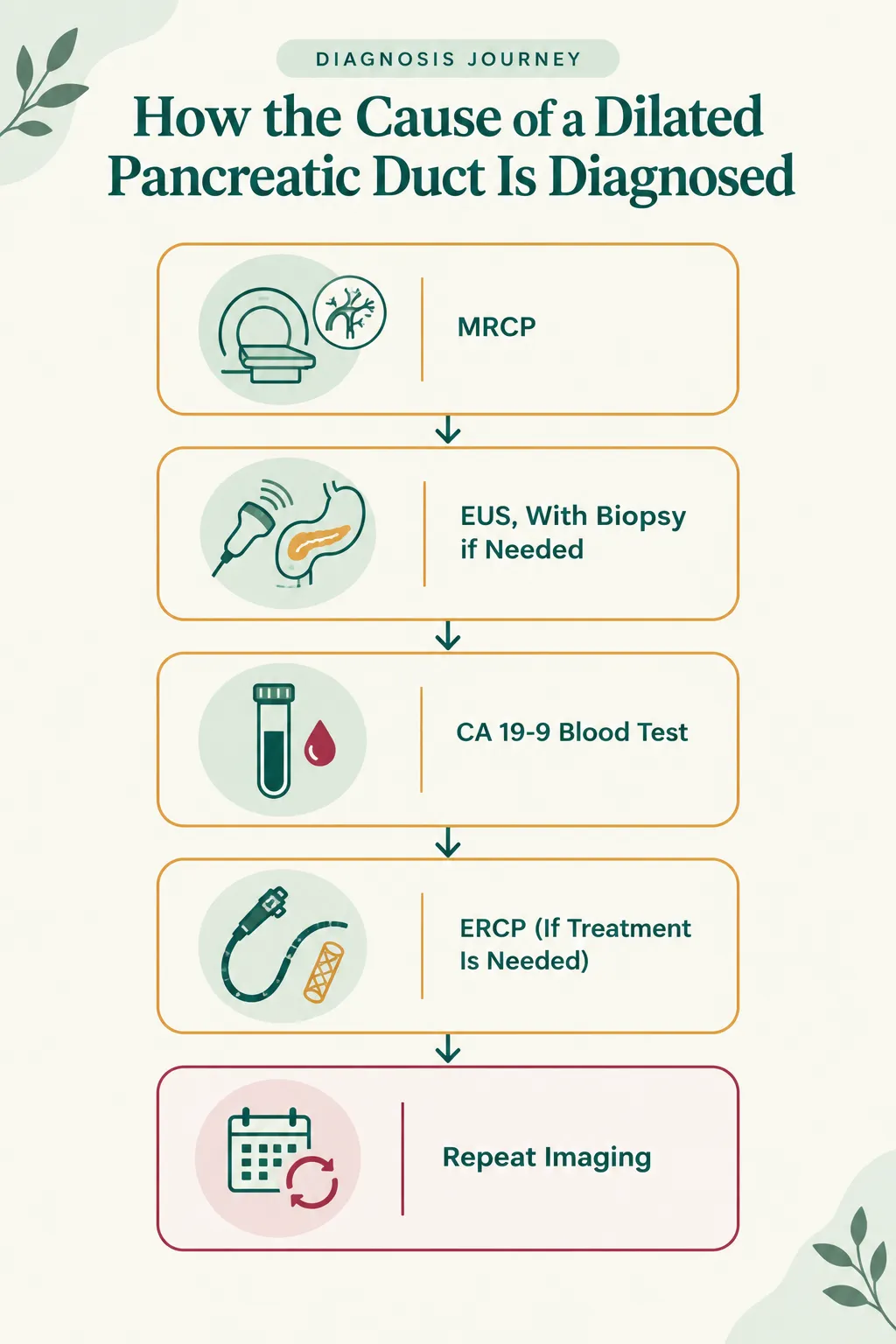
A blood test called CA 19-9 sometimes gets added into the picture, though it’s not precise enough on its own to confirm or rule out cancer. When a stricture actually needs treating rather than just viewing, ERCP steps in — it combines imaging with the ability to intervene directly, placing a stent or clearing a blockage in one procedure. And when the first round of tests doesn’t fully explain what’s going on, doctors will often simply repeat the imaging a few months later to see if anything has shifted.
An unexplained finding on imaging deserves a clear answer, not ongoing uncertainty. Schedule an Evaluation.
When Should You See a Doctor for a Dilated Pancreatic Duct?
Any newly found dilation is worth a proper look, symptoms or not, since imaging alone can’t always separate a harmless cause from one that needs attention. That’s especially true for anyone over 50, with a family history of pancreatic cancer, or dealing with new digestive symptoms that don’t quite add up. Sitting back to see if it resolves on its own isn’t really the move here — the goal is identifying the cause early, while the options for doing something about it are still simple.
Routine Follow-Up
- Small, stable dilation found incidentally
- No symptoms present
- A plausible benign explanation (e.g. old pancreatitis)
- No change on repeat imaging
Seek Prompt / Urgent Care
- Jaundice (yellowing skin or eyes)
- Significant unintentional weight loss
- Persistent, severe abdominal pain
- New-onset diabetes alongside the finding
A handful of symptoms call for moving faster than a routine follow-up would allow. Jaundice, real unintentional weight loss, abdominal pain that won’t let up, or new diabetes showing up alongside the dilation are all reasons to get seen promptly rather than wait for the next scheduled visit. On the other end, a small, stable dilation discovered by chance, with nothing else going on and a reasonable benign explanation, is usually something a gastroenterologist just keeps an eye on over time rather than treats as urgent.
Key Takeaway
A dilated pancreatic duct isn’t automatically cancer — it’s a signal worth investigating, and finding out what’s actually behind it early is what matters most.
Medical Disclaimer: This article is intended for general educational purposes only and does not replace an individual medical evaluation. The causes and significance of pancreatic duct dilation vary by patient, and interpretation should always come from a qualified healthcare professional reviewing the actual imaging.
FAQs
Does a dilated pancreatic duct always mean pancreatic cancer?
Not necessarily. In most cases, there is a benign cause for dilated ducts – chronic pancreatitis, a duct stone, or a stricture. There are a number of possibilities, and cancer is one of them, and it’s the reason it should be looked into, not taken for granted either way.
What size pancreatic duct dilation is worrisome?
An average duct is less than 3 mm in length. Dilation between 5 and 10 mm is more likely to be investigated, particularly if it has no obvious benign cause, and anything larger is even more seriously investigated.
Is it possible for chronic pancreatitis to be associated with a dilated duct without cancer?
Yes, quite often. One of the most frequent benign causes of duct dilation is chronic pancreatitis, where the duct is slowly compressed by scarring, narrowing and sometimes stones formed from years of inflammation.
What do you mean by double duct sign, and why is it important?
It refers to simultaneous dilation of both the pancreatic and bile duct. It does crop up more frequently with a tumour where the two ducts come together, and so is not something that doctors ignore.
Does an incidental dilated pancreatic duct pose a problem?
Typically, no, unless it is mild and there is a good reason such as a previous attack of pancreatitis. Nevertheless, this is usually only enough for a single proper evaluation to make sure what is probably happening is correct.
Should the dilated pancreatic duct be followed?
The truth is that it is actually dependent on the size, believed source, and if there is any thing concerning comes up in conjunction with it. The length of time the gastroenterologist will choose to leave the interval between monitoring sessions depends upon the individual’s findings and is typically between 6 and 12 months.
Medical Sources
- “Intraductal Papillary Mucinous Neoplasm (IPMN)” — Cleveland Clinic
- “Dilatation of the Main Pancreatic Duct of Unknown Origin: Causes and Risk Factors of Pre-Malignancy or Malignancy” — PubMed