
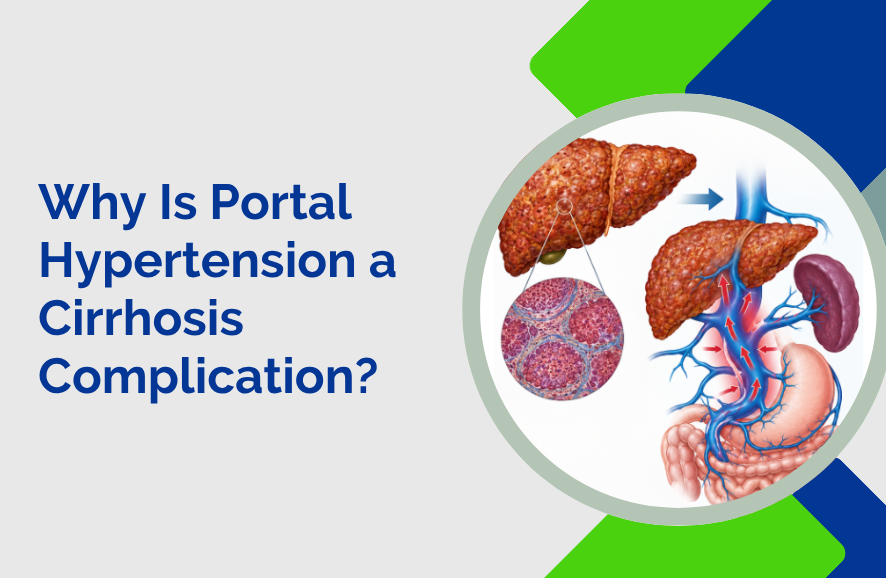
The blood leaving the gut has to pass through the liver before it heads back to the heart. Cirrhosis slows that trip, and the pressure in the portal vein climbs. That’s portal hypertension. Doctors grade it with the hepatic venous pressure gradient. Above 5 mmHg is abnormal, and 10 mmHg or higher is clinically significant, which is when complications become likely. Of all the causes inside the liver, cirrhosis comes first.
According to Dr. Ksheetij Kothari, a gastroenterologist in Pune, “Portal hypertension rarely announces itself early. Many patients feel fine until bleeding or fluid in the abdomen appears, which is why a cirrhotic liver needs regular monitoring.”
What Causes Portal Hypertension in Cirrhosis?
Two things push the pressure up in cirrhosis. The liver gets harder to pass through, and more blood is arriving from the gut at the same time.
Scar tissue gets in the way: Healthy liver tissue is soft and spongy. Once stiff scars replace it, blood can’t squeeze through as easily.
Liver vessels tighten: A damaged liver makes less nitric oxide, so its tiny vessels narrow. This adds resistance on top of the scarring.
Extra blood from the gut: Vessels around the intestines open up in cirrhosis. The liver gets more flow just when it’s least able to handle it.
Blood takes detours: Some of it spills into thin walled veins that can’t cope with the load. Varices in the food pipe bleed easily.
How far the pressure has risen is worked out through testing, not guesswork. Care for the underlying disease is covered under liver cirrhosis treatment.
What Are the Symptoms of Portal Hypertension?
There may be no portal hypertension symptoms at all for years. Often it’s the first complication that gives it away.
Belly swelling: The abdomen fills with fluid, a problem known as ascites. Trousers stop fitting, and a big build up can make it hard to breathe.
Blood in vomit, or black stools: Usually a swollen vein in the food pipe or stomach has bled. Don’t wait it out, get to a hospital.
Enlarged spleen: Pressure backs up into the spleen and it swells. It then holds on to platelets, so you bruise or bleed more easily.
Confusion or heavy sleepiness: Ammonia and other toxins slip past the liver and reach the brain. Doctors call it hepatic encephalopathy.
Cirrhosis can stay silent for years before these signs show up. Our piece on living with cirrhosis looks at prognosis and long term management.
How Is Portal Hypertension Diagnosed and Managed?
Diagnosis isn’t one test. It’s blood work, a scan or two, and usually an endoscopy, read together. The aim is to bring the pressure down and prevent a bleed.
Scans: Doppler ultrasound tracks blood flow through the portal vein and measures the spleen. A separate stiffness scan, elastography, shows how scarred the liver is.
Endoscopy: A slim flexible camera is passed down the throat to look for varices in the food pipe and stomach. It’s usually advised for anyone with cirrhosis.
Beta blockers: Drugs like propranolol and carvedilol bring portal pressure down. That makes a first bleed less likely.
Banding and TIPS: Banding puts small rubber bands around swollen veins during an endoscopy. TIPS is a shunt for bleeding that keeps coming back.
Bleeding from varices counts as an upper GI bleed, and it needs urgent care. The approach to GI bleeding treatment is explained in more detail on that page.
Key Takeaways: In short, portal hypertension is a rise in pressure in the vein that feeds the liver, and cirrhosis is behind most cases. Symptoms often don’t appear for years. Then it can show as a swollen belly, vomiting blood, black stools, easy bruising or confusion. Checking for varices early, along with beta blockers or banding, cuts the risk of a serious bleed.
Living with cirrhosis and unsure whether portal hypertension is developing?
FAQs
What does portal hypertension actually mean?
The pressure in the portal vein is too high, usually due to cirrhosis.
What portal hypertension symptoms should I look out for?
Belly swelling, blood in vomit, black stools, easy bruising, and sometimes confusion.
Can portal hypertension be reversed?
Not in advanced cirrhosis. Early on, treating the cause can bring it down.
How is portal hypertension found?
Mostly through scans, blood tests and an endoscopy that looks for varices.
References:
- PMC (NIH), Regression of Portal Hypertension: Underlying Mechanisms and Therapeutic Strategies: https://www.ncbi.nlm.nih.gov/pmc/articles/PMC7886770/
- PMC (NIH), Noninvasive Evaluation of Portal Hypertension: Emerging Tools and Techniques: https://www.ncbi.nlm.nih.gov/pmc/articles/PMC3376538/
Disclaimer
This blog is for educational and informational purposes only and is not a substitute for professional medical advice, diagnosis, or treatment.