
Medically Reviewed by Dr. Ksheetij Kothari, MBBS, M.D (Medicine), D.M (Gastroenterology)
Most people picture diarrhea when they hear Crohn’s disease. That’s why it so often gets missed in someone with gnawing belly pain, a few kilos gone, and a tiredness that won’t lift, yet whose bathroom habits seem completely ordinary. When the disease is in the small intestine, loose stools may be occasional, mild, or simply not there, and some people become constipated instead. The pain, the shrinking appetite, and the slow weight loss tell the real story. Once it’s clear that Crohn’s disease doesn’t always follow the textbook, the diagnosis tends to come sooner.
“Normal stools don’t rule out Crohn’s disease. In the small intestine, the signs are often pain after meals, weight loss, and fatigue, which is exactly why the condition can take a while to identify.” — Dr. Ksheetij Kothari, Gastroenterologist in Pune
What Symptoms Can Small-Intestinal Crohn’s Disease Cause Besides Diarrhea?
People typically first notice the pain. It usually develops on the right side of the abdomen, and gets sharper after eating, when food passes through the inflamed part of the bowel. This is frequently accompanied by nausea, bloating, decreased appetite, until eating becomes more an obligation than enjoyment. Weight simply drops off, and at a slow pace that can be missed for months. Fatigue also accompanies the inflammation and is due to a poorly functioning small intestine’s inability to absorb nutrients.
Pain After Meals
Tap to read
Often low on the right side of the abdomen, sharpening as food passes the inflamed bowel.
Nausea and Bloating
Tap to read
Frequently arrive together with a fading appetite
Unintended Weight Loss
Tap to read
Often gradual enough to go unnoticed for months.
Fatigue
Tap to read
From the inflammation itself and from poor nutrient absorption.
Anemia
Tap to read
Low iron or vitamin B12 can cause breathlessness, pallor, and tiredness that rest doesn’t fix.
Mild Fever
Tap to read
A low-grade temperature can appear while the disease is active.
The poor absorption can lead to issues unrelated to the digestive system. Anemia, due either to low iron or low vitamin B12 can cause someone to become breathless, pale and tired, and this makes it impossible to get a good night’s sleep, and a temperature may rise slightly while the disease is in its active stage. A constricted section of bowel acts in a different way again. If crampy pain, vomiting, a bloated abdomen and inability to pass stool or gas are indications of a blockage setting in, they are no place to leave them to develop.
Quick Note: Normal bowel movements don’t rule out Crohn’s disease. If the inflammation is limited to the small intestine, pain, weight loss, and fatigue may be the only clues.
Persistent pain, weight loss, or fatigue without a clear explanation is worth investigating properly, even when bowel habits look normal.
What Causes Crohn’s Disease to Affect the Small Intestine Without Changing Bowel Movements?
Crohn’s disease originates from an immune response disorder causing inflammation in the gut. Various variables including genetic factors, presence of certain microorganisms, or surrounding ecological conditions come into play. The cause of Crohn’s disease, however, is yet to be established. Crohn’s disease symptoms depend heavily on the localization of the inflammation. In the case, where the disease leaves the colon unaffected and stays in the small intestine, typical symptoms of the illness may not reveal themselves.
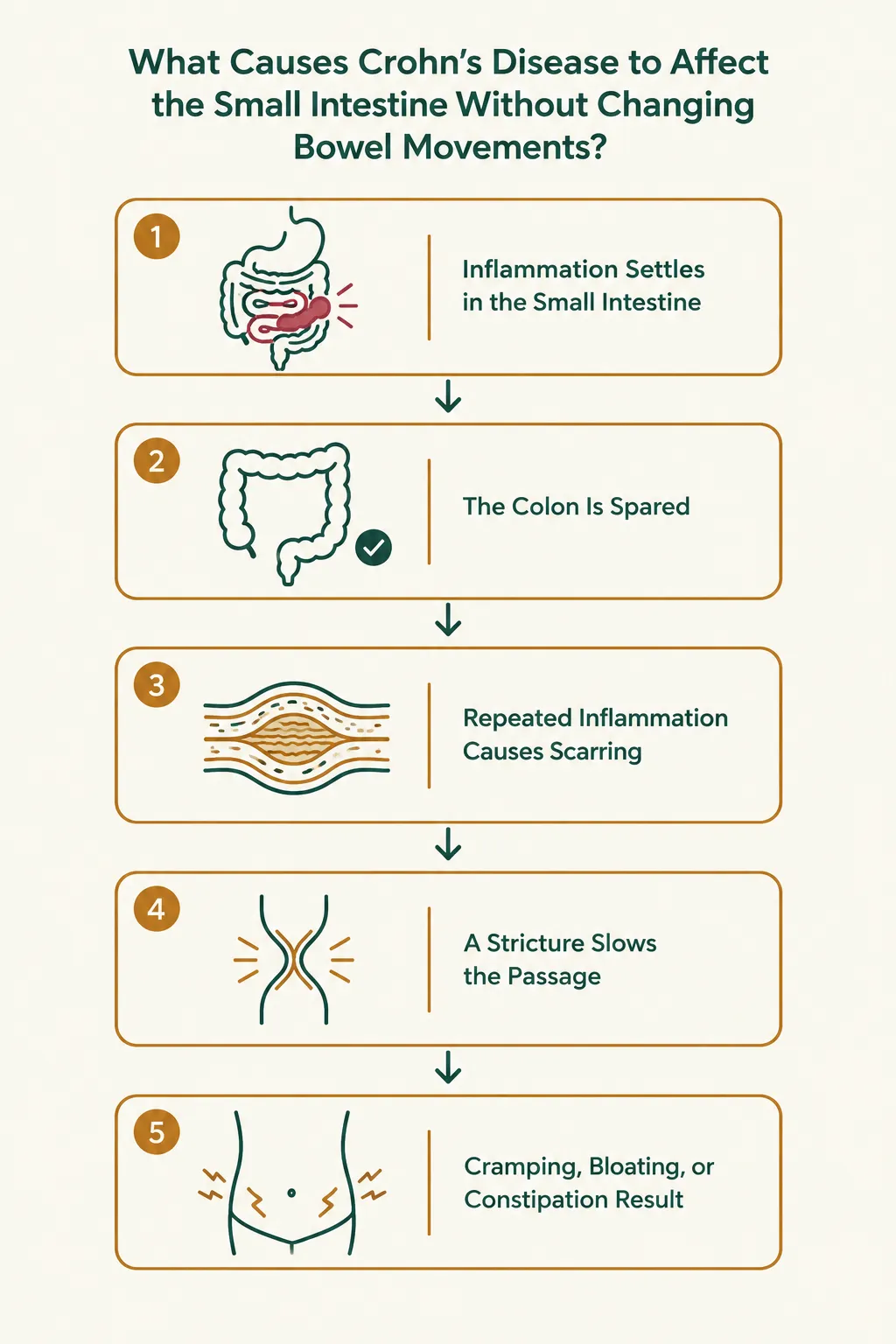
Scarring is another complication, as each inflammatory attack causes the bowel wall to become thicker and form scar tissue. The bowel itself gets narrower or forms what is termed as stricture. Food instead of passing through the narrowed part of the bowel drops towards the end, which is why pain and bloating occur instead of diarrhea. Factors that make stricture formation even more probable include having small bowel disease, smoking, being diagnosed under the age of 40, and being carriers of genes like NOD2 that are involved in distinguishing harmless bacteria from pathogens.
How Is Crohn’s Disease of the Small Intestine Treated?
The first goal is to quiet the inflammation, and for most people with active small-bowel Crohn’s that means starting a biologic medicine, sometimes alongside an immunomodulator, which turns down an overactive immune system. Steroids can calm a flare in the short term, but doctors avoid leaning on them for long. A narrowed stretch that is still inflamed may well open up with treatment, so there’s little to gain by waiting. Food matters too: low iron and vitamins get topped up, and weight is helped back in the right direction.
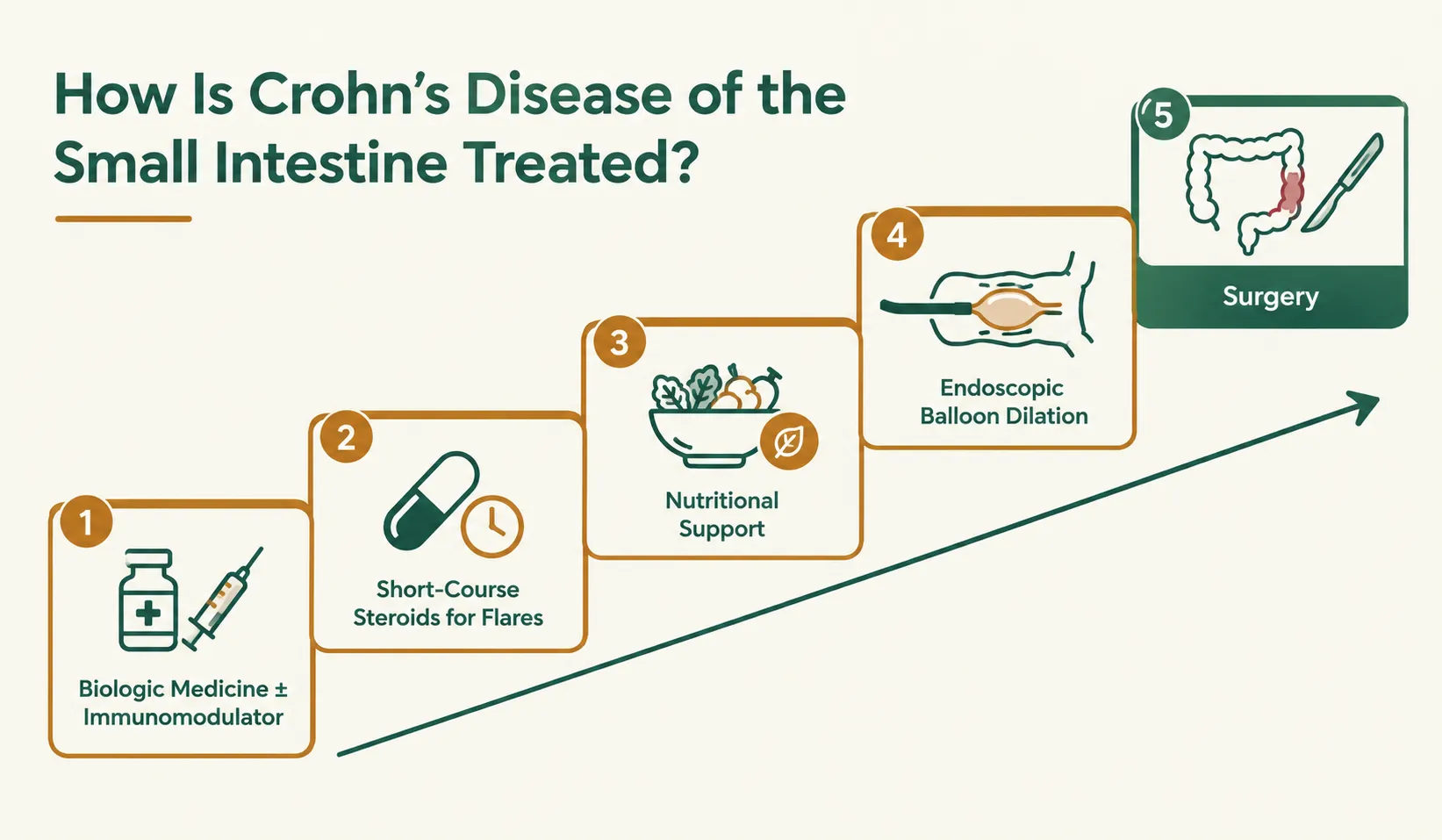
A stricture that has mostly turned to scar is a different matter, because medication has very little left to act on. When it’s short, around 5 cm or less, it can often be stretched open with a balloon during endoscopy, a procedure with complications in fewer than 3% of cases that can delay surgery or occasionally avoid it. Longer or multiple strictures, or ones tangled up with an abscess or a fistula (an abnormal tunnel between loops of bowel), generally need an operation. Surgeons either widen the narrowed segment, called strictureplasty, or remove the diseased stretch.
An unexplained finding on imaging deserves a clear answer, not ongoing uncertainty. Schedule an Evaluation.
When Should You Seek Medical Attention for Possible Small-Intestinal Crohn’s Disease?
Belly pain that lingers, especially after meals, is worth getting checked, as are unexplained weight loss, lasting fatigue, or anemia with no clear cause. Normal bowel movements shouldn’t be a reason to hold off. Symptoms that drag on for more than a few weeks, or keep coming back, are reason enough to see a doctor. Rectal bleeding is less typical when the disease is limited to the small intestine, but it still needs to be looked at promptly.
Book an Evaluation
- Belly pain that lingers, especially after meals
- Unexplained weight loss
- Lasting fatigue or unexplained anemia
- Symptoms lasting weeks or that keep returning
Seek Same-Day Care
- Severe cramping with repeated vomiting
- A hard, swollen abdomen
- Unable to pass stool or gas
- Severe pain with fever
Some symptoms can’t wait for a clinic slot. Severe cramping with repeated vomiting, a hard, swollen abdomen, or an inability to pass stool or gas can mean the bowel is blocked. Severe pain with fever may signal a perforation or abscess. Neither is common, though both are serious. A simple way to sort it out: pain that comes on suddenly, feels severe, or arrives with vomiting or fever should be seen the same day.
Key Takeaway: Normal bowel movements don’t rule out Crohn’s disease, so ongoing pain, weight loss, or fatigue is worth investigating whatever the stools are doing.
FAQs
Can Crohn’s disease affect the small intestine without diarrhea?
Yes. Diarrhea is often present, but not always. When inflammation remains in the small intestine (or a constricted segment delays food transit), the primary symptoms include stomach pain, bloating, loss of appetite, loss of weight and fatigue, with some individuals developing constipation.
Does Crohn's disease make you constipated?
It can, particularly when bowel narrowing occurs from a stricture and the bowel slows down. Constipation and extreme cramping and vomiting can indicate obstruction and requires urgent medical attention.
Crohn's typically attacks which part of the small intestine?
The ileum, the final part of the small intestine, is one of the more common sites. Disease more proximal in the small bowel is less frequent, but can have a higher risk of strictures.
When bowel movements are normal, how is small-bowel Crohn's diagnosed?
They are typically pieced together from multiple tests, including blood tests, colonoscopy which goes to the end of the ileum with biopsies, and MR or CT enterography which is a scan that will provide a detailed picture of the small bowel. Capsule endoscopy is reserved for selected patients as a segment may become constricted and capture the capsule.
Medical Sources
- “Intraductal Papillary Mucinous Neoplasm (IPMN)” — Cleveland Clinic
- “Dilatation of the Main Pancreatic Duct of Unknown Origin: Causes and Risk Factors of Pre-Malignancy or Malignancy” — PubMed