
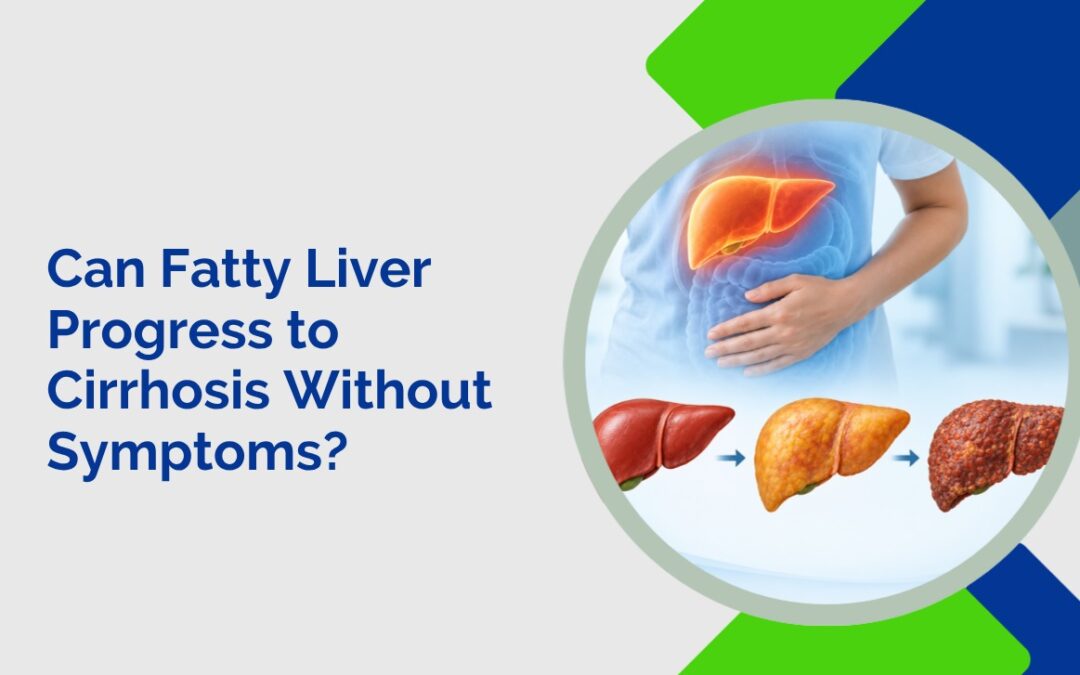
There’s usually no warning. Fatty liver disease can move toward cirrhosis while the person feels fine, since the early and middle stages don’t cause pain or symptoms anyone would link to the liver. Fat, inflammation, and the first scarring can all be there for years. Ten years or more, in some cases. Most people find out by chance, when a routine blood test or an abdominal scan done for something else picks it up. But once scarring reaches the cirrhosis stage it’s largely permanent, so finding it sooner makes a real difference.
According to Dr. Ksheetij Kothari, a Gastroenterologist in Pune, “People expect a liver problem to announce itself. This one rarely does. By the time someone feels unwell, the scarring has usually been building for years, which is why checking at-risk patients matters more than waiting for symptoms.”
What Keeps Fatty Liver Disease Quiet for Years?
The liver keeps working well even when part of it is damaged, so early disease gives little away.
Early disease gives little away: Fat build-up and mild inflammation seldom cause symptoms. A few people report tiredness or a dull ache under the right ribs, and that’s about it.
A normal blood report isn’t proof: Liver enzymes can stay in the normal range while scarring is already forming.
Ultrasound picks up fat, not scarring: It can say the liver is fatty but can’t show how much scar tissue is present.
Symptoms come late: Swelling in the legs or abdomen, yellowing of the eyes, easy bruising, and confusion tend to appear only after cirrhosis is well established.
The treatment approach depends on the cause and the stage, and is outlined under fatty liver disease treatment.
How Fast Is Fatty Liver to Cirrhosis Progression?
Slower than most people fear, though it varies a lot. Odd how rarely that second part gets mentioned.
The average pace: Paired biopsy studies show about one stage of scarring every 14 years with simple fatty liver, and every 7 years once inflammation (NASH) is present.
It isn’t a straight line: In one pooled review, about a third of patients progressed, 43% stayed the same, and 22% actually improved.
Some patients progress fast: One analysis found that roughly one in five patients who started with little or no scarring had advanced fibrosis about six years later.
Things that make it worse: Type 2 diabetes, excess weight, older age, regular drinking, and inflammation already seen on biopsy.
The earliest stage, and what it looks like, is covered in the piece on stage 1 fatty liver.
How Can Hidden Scarring Be Found Early?
Since symptoms can’t be relied on, doctors look for scarring directly in people at higher risk. Most doctors start with a blood-based score and move to a scan if needed.
Blood-based score: FIB-4 combines age, AST, ALT, and platelet count from an ordinary blood test to estimate how likely significant scarring is.
Stiffness scan: FibroScan (transient elastography) measures how stiff the liver is, which increases as scarring builds. It takes about 10 to 15 minutes and doesn’t need a needle.
People who should be checked: Anyone with type 2 diabetes, obesity, metabolic syndrome, or heavy alcohol use, and those whose scan has already shown fatty liver.
How often to repeat it: Typically once every year or two. Sooner if risk factors are present or the first result was borderline.
Stiffness readings can also be tracked over time to see whether weight loss and other changes are helping. How the test works and who it suits is explained in this FibroScan test guide.
Key Takeaways : Fatty liver to cirrhosis progression is usually slow but hard to predict, and it can happen without symptoms. Neither blood tests nor ultrasound reliably show scarring, so people with diabetes, obesity, or heavy alcohol use should ask about a stiffness check. If it’s found before cirrhosis sets in, the damage can often be slowed and sometimes partly reversed.
Living with cirrhosis and unsure whether portal hypertension is developing?
FAQs
Can fatty liver scar the liver without you noticing?
Yes, scarring can build for years before any symptoms show up.
How long does it take for fatty liver to reach cirrhosis?
Usually many years, though the pace differs a lot from person to person.
Does a normal liver function test mean there’s no scarring?
No, enzymes can look normal even when scarring is already present.
Can early liver scarring from fatty liver get better?
Often, with sustained weight loss and better control of blood sugar and cholesterol.
References:
- PubMed: Fibrosis Progression in Nonalcoholic Fatty Liver vs Nonalcoholic Steatohepatitis, A Systematic Review and Meta-Analysis of Paired-Biopsy Studies: https://pubmed.ncbi.nlm.nih.gov/24768810/
- PMC (NIH): The 20% Rule of NASH Progression, The Natural History of Advanced Fibrosis and Cirrhosis Caused by NASH: https://pmc.ncbi.nlm.nih.gov/articles/PMC7504908/
Disclaimer
This blog is for educational and informational purposes only and is not a substitute for professional medical advice, diagnosis, or treatment.