
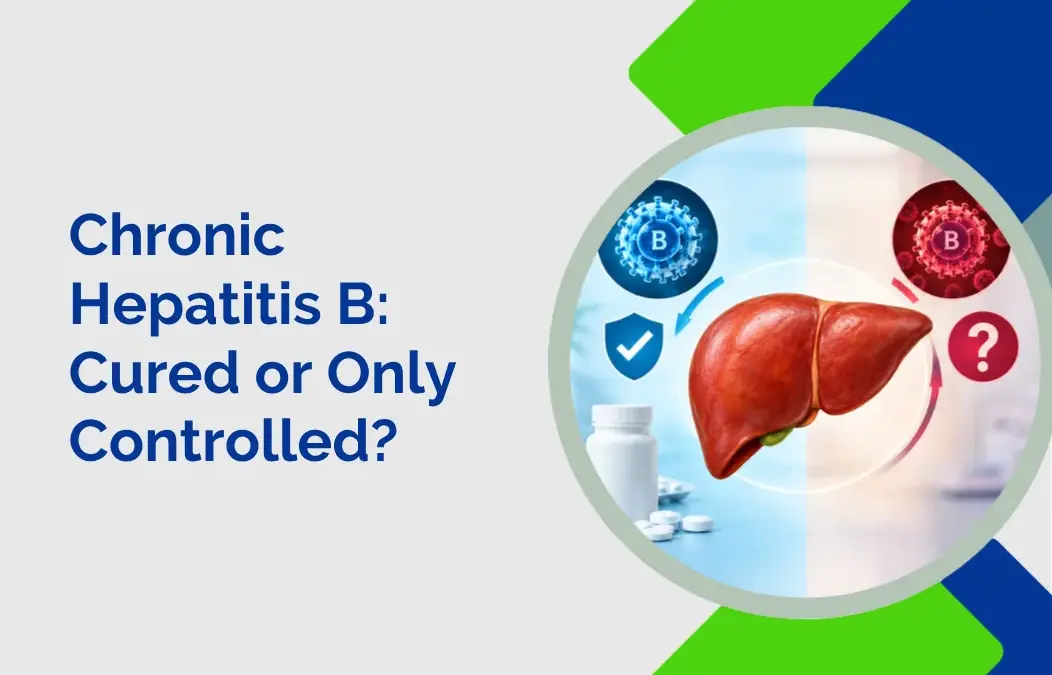
Chronic hepatitis B usually gets controlled, not cured. Daily antivirals or interferon shots can push the virus down and protect the liver, but they rarely clear it out of the liver cells where it actually hides.
According to Dr. Ksheetij Kothari, recognized as one of the best Gastroenterologist in Pune, “Patients often ask if hepatitis B treatment means they’re cured. Controlled is the more honest word, and it’s still a good outcome.”
Is Hepatitis B Curable?
Short answer: rarely, not in the way most people picture a cure.
A true cure means the virus is fully gone: no detectable HBV DNA, no HBsAg, no chance of it flaring back later. Current drugs can’t quite get there.
Antivirals suppress the virus rather than remove it: tenofovir and entecavir drop viral load to undetectable levels in blood, though HBV’s genetic material, cccDNA, still sits inside liver cells.
A functional cure does happen, just rarely: losing HBsAg entirely shows up more often with interferon based treatment than with oral antivirals alone.
Stopping too soon usually brings it back: that’s why most patients stay on hepatitis B treatment indefinitely instead of for a set number of months.
Figuring out where you actually stand takes proper testing, not guesswork. Hepatitis B treatment here starts with confirming viral load and liver status first.
How Is Chronic Hepatitis B Managed Long Term?
Long term care looks more like steady monitoring than a fixed cure.
Blood tests track how well things are controlled: viral load and liver enzymes get rechecked periodically, even once someone’s stable.
Liver damage gets watched on its own track: a fibroscan, or occasionally a biopsy, shows whether scarring has crept in, since damage can progress quietly even with a low viral load.
Some patients trial stopping treatment: only under close supervision, given how often the virus rebounds once medication stops.
Everyday habits still matter: skipping alcohol and getting the hepatitis A vaccine both ease the load on a liver that’s already working harder than it should.
Liver monitoring matters well past hepatitis B alone. Our piece on cirrhosis prognosis covers what that tracking looks like once damage has already set in.
Why Choose Dr. Ksheetij Kothari for Hepatitis B Management?
Dr. Ksheetij Kothari completed his DM in Gastroenterology at St. John’s Medical College Bangalore. He also holds fellowships in Advanced Endoscopy and Endoscopic Ultrasound. As a liver specialist in Pune he puts viral load and liver monitoring ahead of any treatment decision, tracking both together rather than acting on a single test result.
Ongoing monitoring shapes how hepatitis B is actually managed. Call 9765180181 to have your liver health properly evaluated.
Living with hepatitis B and unsure if your treatment is actually working?
FAQs
Is hepatitis B curable?
Not usually. Long term control is the realistic goal for most patients.
What is hepatitis B treatment used for if not a cure?
Mainly to suppress viral activity and shield the liver from harm.
Can you stop hepatitis B treatment once it's working?
Sometimes, but only with close medical supervision to catch any rebound.
What is a functional cure for hepatitis B?
Losing HBsAg entirely, something only a small number of patients reach.
References:
- Centers for Disease Control and Prevention (CDC) — Treatment of Hepatitis B: https://www.cdc.gov/hepatitis-b/treatment/index.html
- PubMed — Current Best Practice in Hepatitis B Management and Understanding Long-term Prospects for Cure: https://pubmed.ncbi.nlm.nih.gov/36243037/
Disclaimer
This blog is for educational purposes only and isn’t a substitute for medical advice. Consult a doctor for symptoms or concerns.