
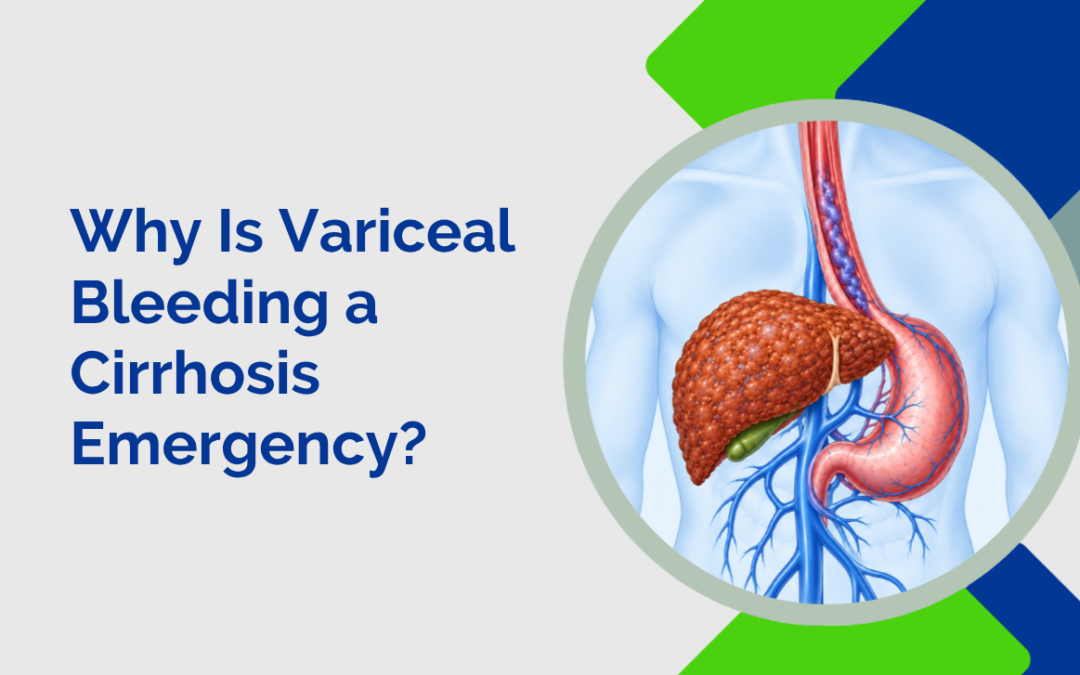
In cirrhosis the liver turns stiff, and blood coming up from the gut has trouble getting through it. It backs up in the portal vein and looks for a way around, mostly through thin veins in the lower esophagus and upper stomach. Those veins can’t handle the extra load. They swell into varices, and when one tears, the bleeding is fast and heavy. A lot of patients only find out about their varices when one bleeds. Studies suggest about 15 to 20% of people who bleed die within six weeks, even with treatment. But prompt care and prevention change that picture a lot.
According to Dr. Ksheetij Kothari, a Gastroenterologist in Pune, “Variceal bleeding rarely comes with a warning. A patient with cirrhosis can feel fine in the morning and be vomiting blood by evening. That’s why checking for varices matters long before any bleeding happens.”
What Are the Signs of Variceal Bleeding?
Variceal bleeding is a form of upper GI bleeding, and once it starts it’s hard to miss.
Vomiting blood: It can be bright red or dark and grainy, like coffee grounds. The amount is often large.
Black, tarry stools: Blood that’s been through the gut turns stool black, sticky and foul smelling. This can be the first sign, before any vomiting.
Signs of blood loss: Patients get dizzy and clammy, the pulse races and blood pressure drops. Some faint.
Often painless: Unlike an ulcer, a bleeding varix usually doesn’t hurt. Families can mistake that for a minor problem.
Ulcers can bleed in much the same way, so the first job is to find the source. That’s where GI bleeding treatment starts.
Why Do Varices Form and Burst?
Pressure is the whole story. It builds quietly for years, and nothing is felt until a vein gives way.
Scarring blocks portal flow: Blood has to push through a stiff, scarred liver, so pressure climbs in the portal vein behind it. That pressure is portal hypertension.
Blood takes detours: Some of it finds other routes back to the heart, mainly through veins in the lower esophagus and upper stomach. Varices appear once the pressure gradient passes about 10 mmHg, and about half of people with cirrhosis get them.
The walls are thin and strained: These veins weren’t built for that pressure. On endoscopy, big varices and red marks on their surface warn doctors that a bleed is more likely.
Bleeding is hard to stop: Cirrhosis often leaves platelets and clotting proteins low, so a tear keeps bleeding longer than it should.
Our piece on living with cirrhosis covers what the years after diagnosis can look like.
What Happens in Hospital When Varices Bleed?
Treatment starts in minutes, sometimes before anyone has seen the bleeding vein. Every hour of bleeding adds to the risk.
Fluids and drugs: Fluids and blood are given carefully, since too much raises portal pressure again. Terlipressin or octreotide lowers it, and antibiotics head off infection.
Endoscopy, ideally within 12 hours: In the esophagus the doctor slips a small rubber band over the bleeding vein to shut it. Varices in the stomach are usually closed with a glue injection.
If bleeding continues: A balloon tube or a stent can buy some time. TIPS, a shunt placed through a vein in the neck to ease portal pressure, is kept for bleeding that won’t stop or is likely to return.
Stopping a second bleed: Beta-blockers such as propranolol or carvedilol work alongside repeated banding sessions, and alcohol has to stop. Without these, many patients bleed again.
Variceal bleeding treatment doesn’t end when the bleeding stops, because the cirrhosis behind it is still there. For the ongoing care of the liver itself, see cirrhosis treatment.
Key Takeaways: In short, variceal bleeding is what happens when swollen veins in the esophagus or stomach rupture under portal hypertension, and it can become fatal within hours. In someone with cirrhosis, vomiting blood or black stools should be treated as variceal bleeding until another cause is proven. Variceal bleeding treatment uses drugs and band ligation, with TIPS in some cases, and screening endoscopy, beta-blockers and banding lower the chance of a second bleed.
Has a doctor ever suggested an endoscopy to look for varices?
FAQs
Can varices bleed without any warning?
Yes. They usually cause no symptoms until one ruptures.
How are varices found before they bleed?
By upper endoscopy, which is the standard screening test.
Does variceal bleeding always end in death?
No, though even with treatment the risk of dying is real.
How is another bleed prevented after the first?
Beta-blockers plus repeated banding sessions, and no alcohol.
References:
- PMC (NIH): Gastrointestinal Bleeding in Cirrhotic Patients with Portal Hypertension: https://www.ncbi.nlm.nih.gov/pmc/articles/PMC4890899/
- PMC (NIH): Management of Complications of Portal Hypertension: https://www.ncbi.nlm.nih.gov/pmc/articles/PMC6582830/
Disclaimer
This blog is for educational and informational purposes only and is not a substitute for professional medical advice, diagnosis, or treatment.