
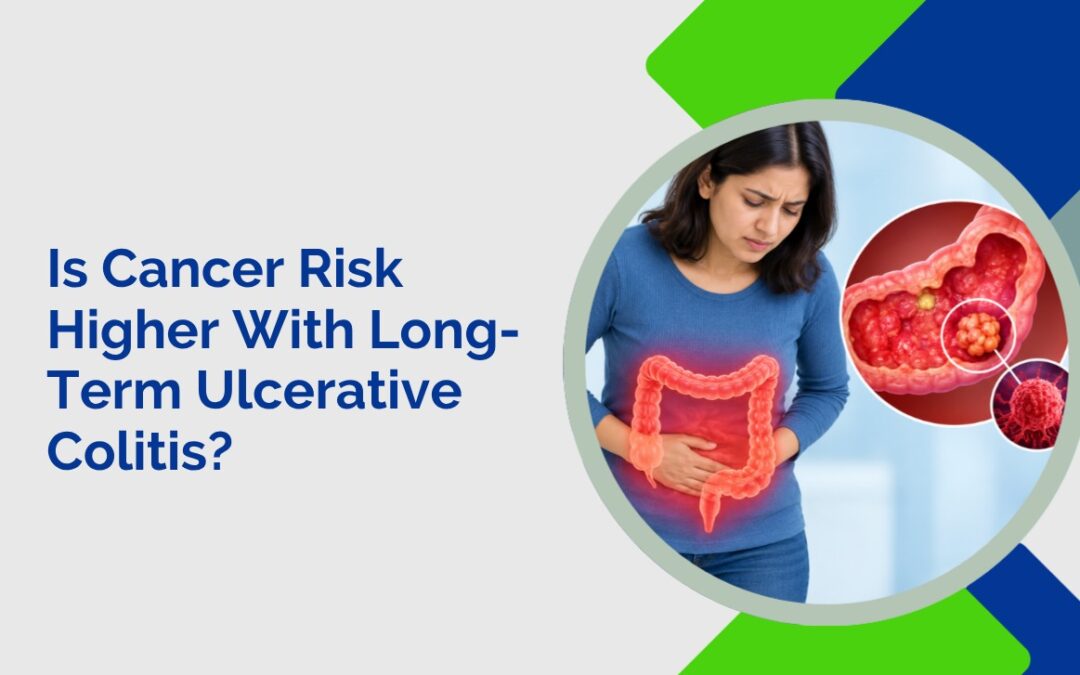
After many years of ulcerative colitis, the odds of colorectal cancer are higher than they are for the general population. That’s the honest starting point. But the numbers have come down a lot from what older studies reported, mostly because inflammation is controlled better now and colonoscopy checks catch trouble early. So the risk is real, and it’s also manageable. The large majority of patients never develop colorectal cancer at all.
According to Dr. Ksheetij Kothari, a Gastroenterologist in Pune, “The risk is real, but it builds slowly, over years of inflammation. That slow build is why it can be watched for. A colonoscopy done at the right interval usually finds abnormal cells long before they turn into cancer.”
What Pushes Ulcerative Colitis Cancer Risk Higher?
Several things raise it, and many patients have more than one of them.
Time since symptoms began: Risk climbs with each year of active disease. One large review found about 1 cancer per 1,000 patient-years in the first decade, and roughly 4 to 4.5 per 1,000 in the second and third.
How far the colitis reaches: Disease that involves the whole colon is riskier than disease that stays in the rectum.
Inflammation that keeps coming back: Cells that are damaged and healed repeatedly are more likely to change abnormally. When a colonoscopy shows heavy ongoing inflammation, doctors treat it as a sign of higher risk.
Other risk factors: A bile duct and liver condition called primary sclerosing cholangitis, a close relative with colorectal cancer, or a diagnosis made when young. Each one adds to the total.
How the disease is managed over the years, remission included, is outlined under ulcerative colitis treatment.
Is the Risk Lower Than It Was Decades Ago?
Yes, by a fair margin. Most people remember the oldest figures, which were also the highest.
Older studies looked worse: Data going back to the 1950s showed around 4 cancers per 1,000 patient-years, while more recent work sits closer to 1.2.
Treatment aims at healing the lining: Medicines that heal the bowel wall, not just calm symptoms, probably reduce the long-running inflammation behind the risk.
Scheduled scopes catch it earlier: People who keep up with colonoscopy surveillance tend to be diagnosed at an earlier stage, when treatment is most effective.
Lower still isn’t average: Population-based studies put the risk at roughly double that of people without the disease.
For the bigger picture of living with the condition long term, see the piece on chronic ulcerative colitis.
When Should Colonoscopy Checks Start?
Surveillance isn’t the same as a diagnostic test. It’s a planned check for abnormal cells, carried out even when you feel well.
First check at about 8 to 10 years: Most guidelines place the first surveillance colonoscopy roughly 8 to 10 years after symptoms began, and the count starts from the first symptoms rather than the date of diagnosis.
Sooner for some patients: Anyone who also has primary sclerosing cholangitis usually starts at the time of diagnosis. A close relative with colorectal cancer may move the first check earlier too.
How often it’s repeated: Somewhere between yearly and every five years, depending on what the last scope showed. A healed, healthy-looking colon allows longer gaps. Ongoing inflammation or abnormal cells found before mean shorter ones.
How the checks are done: The doctor takes biopsies from several parts of the colon. Dye spraying or a high-definition scope helps find flat patches that are easy to overlook.
A surveillance colonoscopy also shows how well treatment is working, which is useful whether or not anything abnormal turns up. Preparation and what to expect on the day are explained in this colonoscopy procedure guide.
Key Takeaways : Ulcerative colitis cancer risk rises mostly after eight to ten years of disease, and more so when the whole colon is involved. The risk has fallen with better treatment, but it’s still roughly double that of the general population. Colonoscopy surveillance that begins on schedule is the main safeguard. Many people live with ulcerative colitis for decades and never develop cancer.
Have you been living with ulcerative colitis for eight years or longer?
FAQs
When does cancer risk start to rise in ulcerative colitis?
Usually after about eight to ten years of having the disease.
Will everyone with ulcerative colitis develop colon cancer?
No, most people with the disease never get colorectal cancer.
Why do doctors advise regular colonoscopy after many years of colitis?
It spots abnormal cells early, when treatment is far more likely to work.
Is cancer risk the same when only the rectum is inflamed?
No, risk is much lower when inflammation stays confined to the rectum.
References:
- PubMed: Systematic Review with Meta-Analysis, The Declining Risk of Colorectal Cancer in Ulcerative Colitis: https://pubmed.ncbi.nlm.nih.gov/24612141/
- PMC (NIH): Cancer Surveillance in Longstanding Ulcerative Colitis, Endoscopic Appearances Help Predict Cancer Risk: https://pmc.ncbi.nlm.nih.gov/articles/PMC1774334
Disclaimer
This blog is for educational and informational purposes only and is not a substitute for professional medical advice, diagnosis, or treatment.