
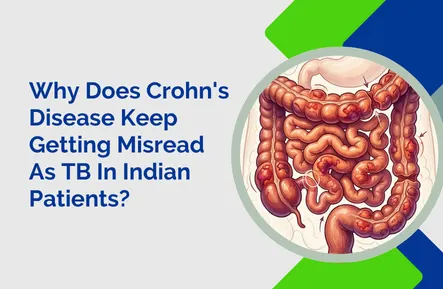
TB is the default read in Indian gastroenterology, and it’s easy to see why. India carries the highest number of TB cases anywhere in the world, so doctors are trained to rule it out first. But Crohn’s disease pays the price for that caution, because it mimics TB almost point for point. A fever that lingers. Weight loss with no obvious trigger. Cramping that returns in the same spot each time. The TB diagnosis often gets written down before Crohn’s gets a real chance.
According to Dr. Ksheetij Kothari, one of the Best Gastroenterologist in Pune, “Patients often reach me after already being on anti-TB medication for six months or more, started elsewhere, with no real improvement to show for it. That delay means scarring that better testing early on could have prevented. Under a microscope, these two conditions are genuinely tough to pull apart.”
What Makes These Two Conditions So Hard To Tell Apart?
They share the same territory in the gut, and most of the same warning signs too.
Symptoms overlap almost completely: Fever, cramps, loose stools that won’t settle, weight dropping off. Ask two patients to describe either disease and the answers sound nearly identical.
Even the tissue looks alike: Granulomas turn up in biopsies from both conditions. Without more context, a pathologist could reasonably call it either way.
TB carries more weight by default here: Indian gastroenterologists see ileocaecal inflammation and TB naturally tops the list. The local numbers shape the first guess before symptoms are even fully reviewed.
Imaging rarely settles the question: Both diseases show up as bowel wall thickening and swollen lymph nodes on CT and MRI. A radiologist reading the scan alone often can’t call it definitively.
Getting this sorted early matters more than most patients realise, and proper Crohn’s disease treatment can only start once TB has genuinely been ruled out, not just assumed.
What Points The Diagnosis Toward Crohn's Instead?
A few signals do lean one way over the other. None decide it alone, but together they build a case.
Track the response to TB drugs: Genuine TB typically improves within six to eight weeks of treatment. No change after that stretch is a strong hint the diagnosis is wrong.
PCR and culture carry weight: A strongly positive TB PCR supports TB. Crohn’s patients almost always come back negative on these same tests.
Location tells its own story: Crohn’s shows up as skip lesions scattered across the gut. TB tends to stay tight around the ileocaecal area instead.
ASCA antibodies show a pattern: These antibodies appear more frequently in Crohn’s patients than in TB cases. It’s not conclusive alone, but it adds to the overall read.
Rectal bleeding accompanying these symptoms is a detail worth investigating further, a pattern examined in our piece on Crohn’s disease bleeding.
Why Choose Dr. Ksheetij Kothari?
Dr. Ksheetij Kothari has spent years managing complex inflammatory bowel disease cases where the TB versus Crohn’s question wasn’t obvious on the first visit. As a consultant gastroenterologist at Sahyadri Hospital, he relies on a combination of endoscopy, biopsy, and treatment response rather than settling for one test result. Because misdiagnosis here isn’t rare, his approach leans toward confirming before committing a patient to months of wrong medication. That carefulness is what separates a fast diagnosis from a correct one.
Patients who’ve been on anti-TB treatment without improvement often come to him for a second opinion, and that second look matters. He reviews the full history, repeats the relevant tests where needed, and doesn’t rush to relabel a case without solid evidence either way. Getting it right the first time saves months of unnecessary treatment. Call +91 97651 80181 to book a consultation.
Weeks of TB treatment with no real change is a signal, not a coincidence. Get it checked again.
FAQs
Why do Indian doctors lean toward TB first?
TB is common here, so it’s checked before Crohn’s disease.
Can lab tests alone diagnose Crohn's disease?
No, doctors combine biopsy, blood work, and treatment response together.
What happens if Crohn's is treated as TB?
The real disease keeps damaging the gut while nothing improves.
When should a Crohn's diagnosis be reconsidered?
If TB treatment shows no improvement after eight weeks.
References:
Disclaimer
This blog is for educational purposes only and isn’t a substitute for professional medical advice; consult a qualified doctor for any symptoms or concerns.