
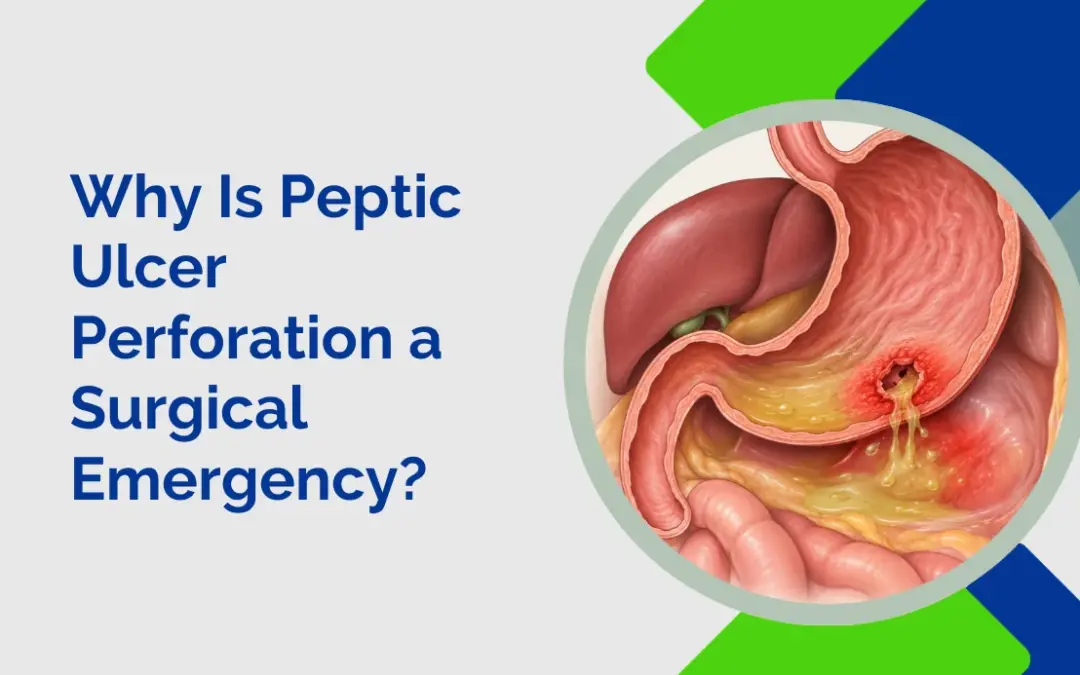
A perforated ulcer has worn a hole through the wall of the stomach or duodenum. Acid, digestive juices, and bacteria then leak out into the abdomen, a space that should be sterile. Inflammation of the abdominal lining (peritonitis) can follow within hours, and from there the infection can spread into the blood as sepsis. Every hour counts. Medicines can’t close the hole, so the treatment is surgery, and earlier surgery means a safer recovery. Studies report death rates from about 5% to 25%, higher in older patients and when surgery is delayed.
According to Dr. Ksheetij Kothari, a Gastroenterologist in Pune, “Patients with a perforation can usually tell you the minute it started. The pain arrives suddenly, and it doesn’t ease with antacids or rest. That’s the point where waiting at home stops being an option.”
What Do the Peptic Ulcer Perforation Symptoms Look Like?
The onset is abrupt, and it doesn’t feel like the usual ulcer burn.
Sudden, severe upper abdominal pain: It comes on like a stab, high up in the middle of the abdomen. Many patients can name the minute it began.
A rigid belly: The abdominal wall muscles go into spasm without any effort, leaving the stomach hard as a board and painful even to a light touch. Any movement, including coughing, makes it worse.
A false calm: After the first few hours the pain can ease for a while as leaked fluid dilutes the acid. But the infection hasn’t stopped building. Anyone who feels better but still has a hard, tender belly shouldn’t wait it out.
Late signs of sepsis: A high temperature, a racing pulse, fast breathing, dizziness, and cold, clammy skin. If air has collected under the diaphragm, the pain may be felt at the tip of the shoulder.
Most ulcers never reach this point, and how they’re diagnosed and treated early is outlined under peptic ulcer treatment.
Which Ulcers Are Most Likely to Perforate?
Most ulcers heal without drama. A few factors push some of them towards a hole. Oddly, for many patients the perforation is the first sign of an ulcer.
Long-term NSAID use: Diclofenac, ibuprofen, and aspirin are common culprits, particularly at high doses or alongside steroids or blood thinners.
H. pylori that was never treated: The infection keeps the ulcer open, so it can slowly erode deeper into the wall.
Smoking and heavy alcohol use: Healing slows down and the risk of perforation goes up.
Older age with few symptoms: Older adults and regular painkiller users may have an ulcer that hurts very little, so the perforation is the first thing anyone notices.
How common painkillers set this up is explained in the piece on NSAID-induced ulcers.
How Is a Perforated Ulcer Treated?
Treatment starts before the operating theatre and continues long after it, since closing the hole doesn’t deal with what caused it.
Stabilising first: A drip delivers fluids, antibiotics, pain relief, and acid-suppressing medicine, and a tube may be placed in the stomach, while the diagnosis is being confirmed.
Confirming with imaging: Free air under the diaphragm or elsewhere in the abdomen on an X-ray or CT scan points to a perforation.
Surgical repair: The surgeon closes the hole with stitches, usually reinforces it with a patch of omentum, and washes out the abdomen. Both keyhole and open surgery are used. A few stable, carefully selected patients may be managed without an operation, but that’s a hospital decision, never a home one.
Healing the ulcer afterwards: Acid-suppressing medicine carries on, H. pylori is tested for and treated, and NSAIDs are stopped or replaced. Otherwise the ulcer can return.
Perforation is one of several peptic ulcer complications, alongside bleeding and stomach outlet blockage. Bleeding is covered under upper GI bleeding.
Key Takeaways: A perforated ulcer lets acid and bacteria into the abdomen, which is why surgery is needed within hours, not days. The classic peptic ulcer perforation symptoms are sudden severe upper abdominal pain and a hard belly, and a temporary easing of pain doesn’t mean it has passed. NSAIDs, untreated H. pylori, and smoking raise the risk, and treating the ulcer afterwards stops it coming back.
Would you know when ulcer pain means going straight to a hospital?
FAQs
Can a perforated ulcer settle without an operation?
Rarely. Only a few stable, carefully selected patients avoid surgery.
How long can surgery for a perforated ulcer be delayed?
Not long. Waiting beyond 24 hours raises the risk of death.
Is any sudden stomach pain a sign of perforation?
Not always, but severe pain with a hard belly needs urgent care.
Can a perforated ulcer come back after surgery?
Yes, if H. pylori or NSAID use isn’t dealt with.
References:
- PubMed: Perforated and Bleeding Peptic Ulcer, WSES Guidelines (Tarasconi et al., World J Emerg Surg 2020): https://pubmed.ncbi.nlm.nih.gov/31921329/
- PubMed: Systematic Review of the Epidemiology of Complicated Peptic Ulcer Disease, Incidence, Recurrence, Risk Factors and Mortality (Lau et al., Digestion 2011): https://pubmed.ncbi.nlm.nih.gov/21494041/
Disclaimer
This blog is for educational and informational purposes only and is not a substitute for professional medical advice, diagnosis, or treatment.